Fiction drawn from fact. All names, characters, facilities, and events are fictional. Any resemblance to real persons or institutions is coincidental. This story is inspired by documented patterns in American long-term care. It is not based on any single case. Read the full series at nathaliefrias.net.
The brochure said community. The website said compassion. The woman at the front desk said your mother will love it here.
Denise Aldridge-Webb drove forty minutes each way to visit Harmony Hills three times before she signed the paperwork. She walked the hallways. She watched how the staff talked to the residents. She ate lunch in the dining room and counted heads. Fourteen residents. Four staff on the floor. The ratio felt right.
Her mother, Lorraine Aldridge, moved in on a Tuesday in September. Seventy-nine years old. Sharp mind. Bad knees. She needed help with bathing, dressing, and getting in and out of bed. She did not need a nursing home. She needed someone nearby when she called. Assisted living does not require the same federal staffing standards as nursing homes. That distinction matters more than most families realize.
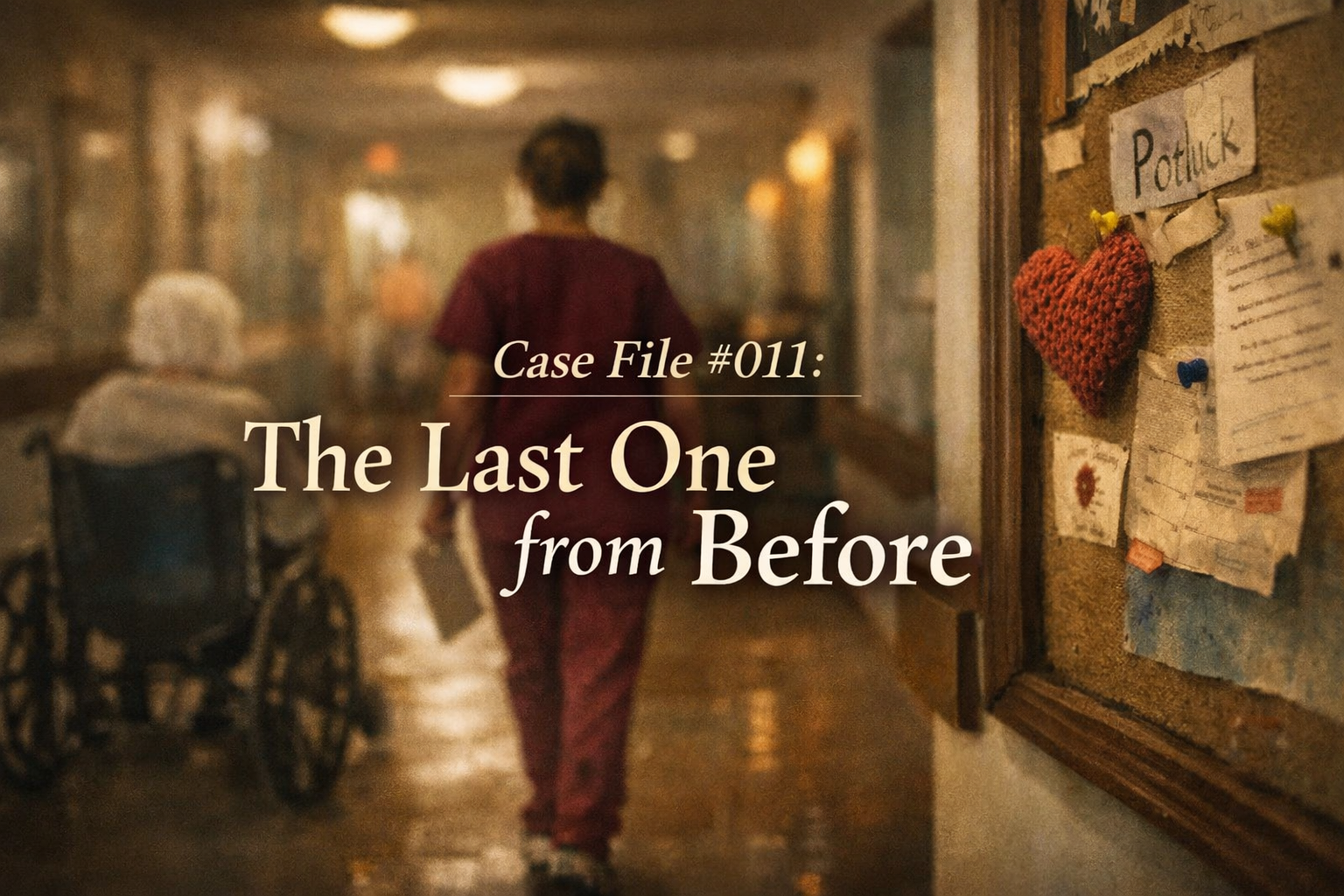
Harmony Hills was a non-profit. The Harmony Hills Community Trust had operated the facility for eleven years. A local board governed it. The director, a woman named Gayle Ostrander, had worked there since it opened. The aides knew the residents by name. The bulletin board in the lobby listed a church potluck, a book club, and a birthday party for a woman turning ninety-one.
For the first four months, Lorraine called her daughter every evening. She talked about the food. She talked about a woman named Pearl who cheated at cards. She talked about the aide who braided her hair on Sundays.
Then, in January, the calls changed.
The first thing Lorraine mentioned was the noise. Construction crews in the parking lot. New signage going up. She said the front desk looked different but she did not know why.
Denise drove out the following Saturday. The Harmony Hills Community Trust logo was gone. In its place, a sleek teal sign read Harmony Hills Senior Living, A Meridian Health Partners Community.
Nobody had told her.
She asked at the front desk. The woman there was new. She smiled and said the transition had been seamless. Denise pressed to speak with Gayle Ostrander. The woman said Gayle was no longer with the facility.
Denise requested the name of the new director. The woman handed her a business card for someone named Todd Rayburn. Regional Operations, Meridian Health Partners. His office was in a city ninety miles away.
By February, Lorraine stopped calling every night. Denise figured she was settling into a routine. When she visited, her mother was in bed at 4:30 in the afternoon. The aide said she had been tired. Denise noticed a bruise on her left forearm. The aide said she must have bumped the bedrail. Her water pitcher was empty. Lorraine said it had been that way since the morning.
By March, Lorraine had lost nine pounds. Her hair was unwashed. She smelled like urine. When Denise asked for the care log, the new aide said she did not know where it was kept.
Denise counted heads in the hallway. Fourteen residents. Two staff on the floor. One aide was passing medications. The other was responsible for everything else.
The ratio had changed.
Denise filed a complaint with the state. She requested her mother’s records. What came back was thin. Progress notes that repeated the same language week after week. “Resident resting comfortably. No complaints voiced. ADLs performed as scheduled.” Copy and paste. Copy and paste. Six weeks of identical entries.
She pulled the staffing schedule through a public records request. Harmony Hills had operated with four aides per shift under the Community Trust. After the Meridian acquisition, that number dropped to two. On three documented occasions, a single aide covered all fourteen residents from 11 p.m. to 7 a.m.
The night shift was where everything fell apart.
Lorraine had pressed her call light seventeen times in one week during the overnight hours. Response logs showed an average wait time of forty-two minutes. On March 9, no response was documented at all. The following morning, an aide found Lorraine on the floor beside her bed. She had tried to get up alone. Her right hip was fractured. No incident report explained the delay.
She was transferred to St. Catherine’s Medical Center. She never returned to Harmony Hills.
At St. Catherine’s, the attending physician noted in the admission record: “Patient presents with moderate malnutrition, stage II pressure injury to sacrum, poor hygiene, and acute hip fracture consistent with unassisted transfer. Findings suggest prolonged inadequate care.”
Denise sat in the hospital hallway and read that sentence three times.
Prolonged inadequate care.
She had visited every two weeks. She had asked questions. She had looked at the building and the staff and the brochure and believed what she saw. What she had not looked at was the ownership. She had not checked CMS. She had not asked who bought the facility or what changed when they did.
She did not know that Meridian Health Partners had acquired four assisted living facilities in Whitmore County in the same twelve-month period. She did not know that staffing reductions followed every acquisition. She did not know that her mother’s decline matched a pattern repeated across every building Meridian touched.
Lorraine Aldridge is recovering. The hip is healing. The pressure wound is closing. She is not going back to Harmony Hills.
Denise filed a second complaint, this time with the Long-Term Care Ombudsman. She included the staffing schedules, the call light logs, and the hospital admission report. She included a letter she wrote herself, three pages, describing what her mother looked like on the day she found her on the floor.
Meridian Health Partners issued a statement through Todd Rayburn’s office. It said the company was committed to high-quality care and was reviewing the matter internally.
The bulletin board in the Harmony Hills lobby no longer lists a book club. It lists a corporate compliance hotline.
Pearl still cheats at cards. But the aide who braided Lorraine’s hair on Sundays is gone. She left in February. She was the last one from before.
Fiction drawn from fact. Every case in this series is inspired by real events in American long-term care.
Read the full series at nathaliefrias.net


Leave a Reply