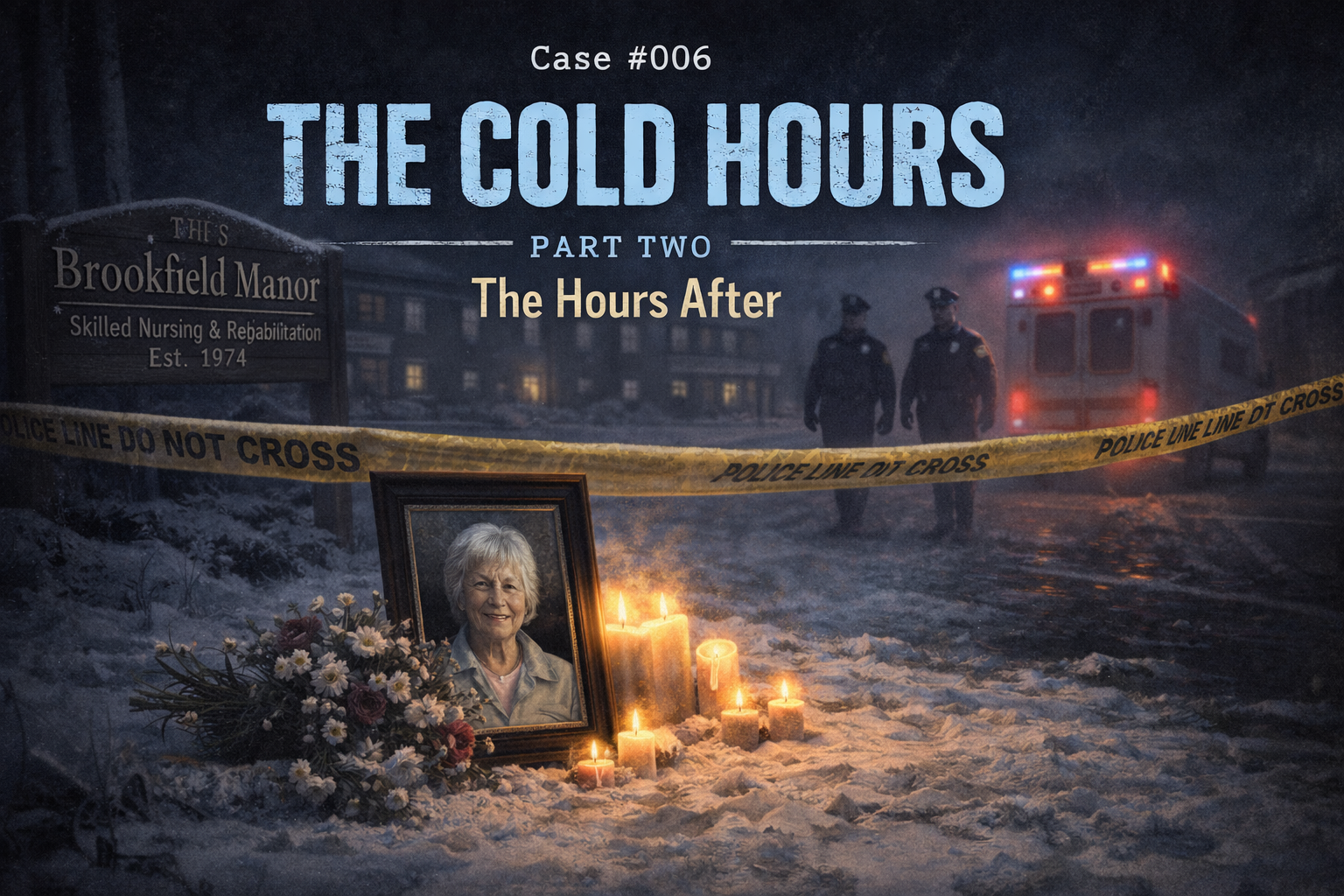
The Hours After
Rosa Vega found the empty bed at 4:42 AM.
She would remember, afterward, the specific quality of the silence in Room 19. Not the absence of sound. Brookfield was never silent. The heating system clanked. The pipes ticked. Somewhere down the hall, a television murmured through a closed door. Room 19 was not silent. But the silence inside it had a different texture than usual. A weight. As if the room knew before Rosa did.
The bed was unmade. The sheets were pulled back to the left, the way Dorothy always pushed them, with her right hand, the hand that had once played Chopin. The pillow held the impression of her head, a shallow oval in the center, still there, the last physical record of the last time Dorothy Paulson had lain in her bed. Rosa stared at the pillow. She would remember staring at the pillow.
She checked the bathroom. She checked the day room. She walked the east wing corridor calling Dorothy’s name, softly, the way you call someone at night in a place where other people are sleeping, where the sound of your voice is an intrusion, where you are still telling yourself that everything is fine, that there is an explanation, that in a moment you will turn a corner and find her sitting in a chair somewhere, confused but safe, and you will walk her back to bed and that will be the end of it.

She told Patricia Weeks at 4:51 AM. Patricia was at the nurses’ station, charting. She looked up when Rosa came in and Rosa saw it happen on Patricia’s face, the shift, the way the expression rearranged itself from tired to something else. Patricia had been at Brookfield for eleven years. She knew what an empty bed at 4:51 AM meant.
They searched together. The west wing. The dining room, where the chairs were stacked on the tables and the overhead lights were off and the room had the hollow, echoing quality of a cafeteria after hours. The activity room with its folding chairs and its jigsaw puzzle of a covered bridge that had been three-quarters finished since October, a thousand pieces scattered on a card table, the picture emerging in fragments the way memory works, almost complete, almost recognizable, but with gaps that would never be filled. They checked behind the front desk. They checked the supply closet. They checked every room they could think of that was not outside, because checking outside meant something they were not yet ready to mean.
At 5:04 AM, Patricia walked to the employee entrance at the back of the building.
The door was open.

Not propped open with the wedge. Open. Swinging slightly in the wind that was still coming through it, a steady current of air so cold it felt solid, like something you could push your hand against. The fluorescent tube above the stoop threw a cone of pale light onto the concrete and the first few feet of gravel. Beyond that, the dark. The parking lot. The road. The sky, starless now, the clouds having moved in from the northwest, low and heavy, the color of ash.
Patricia stepped outside. The cold hit her face like a hand. She looked left, toward the lot. And she saw her.
Dorothy. On the ground. At the edge of the light, where the gravel met the snow. Face down. Still. Her white hair spread on the snow around her head like a halo. Her pajamas, the flannel ones with the small flowers, stiff with frost. Her slip-on shoes still on her feet. Forty feet from the door.
Patricia Weeks would later tell the police that her first thought was not a word but a sound. A ringing. Like the beginning of a very loud noise heard from very far away. She said she stood on the stoop for what felt like a long time but was probably four or five seconds, and in those seconds she thought many things at once: she is dead, I am the charge nurse, the door was open, I should call 911, I should bring her inside, I should not have left the door, I should have checked earlier, the door was open, the door was open, the door was open.
She did not call 911.
She went back inside and got Rosa and a wheelchair.

They brought her in through the employee entrance. Rosa held the door. Patricia wheeled her through the hallway to the nurses’ station. The wheelchair left a trail of water on the floor as the frost on Dorothy’s pajamas began to melt in the warmth of the building. The warmth of the building. The building that had let her out now took her back, its heat wrapping around her the way it wrapped around everything inside it, the furniture, the carpets, the walls, the smell, absorbing her back into itself as if she had never left.
Dorothy’s skin was the color of candle wax. A yellowish white that did not look like skin at all but like something made to resemble skin, a mannequin, a prop. Her lips were the blue of deep water. Her eyes were closed. Patricia pressed two fingers to the side of Dorothy’s neck. She held them there for ten seconds. Fifteen. She said she felt a pulse. She said this to Rosa, who was standing in the doorway, crying, her hand over her mouth. She said it later to the police. A faint pulse. Thready but present. Whether it was real, whether her fingers felt the echo of Dorothy’s heart or the echo of her own, whether she believed it or needed to believe it, no one would ever know.

They wrapped her in blankets. One from the linen closet, then two more from the stack in the supply room. They brought the space heater from the break room, the small oscillating one that the aides used on their feet during overnight shifts, and pointed it at Dorothy’s legs. Patricia rubbed her hands. She rubbed them the way you rub a child’s hands when they come in from playing in the snow, briskly, with friction, as if warmth were something you could transfer from your body to another’s by will alone.
The clock above the nurses’ station said 5:09 AM. The hallway was still empty. No one else in the building had woken. The fourteen other residents slept in their rooms, behind their closed doors, in the building that breathed around them, and none of them knew that in the hallway outside, two women were trying to bring a third woman back from a place she had already gone.
Sixty-nine minutes. From 5:09 to 6:18. More than an hour. They sat with her. They waited. They watched the blankets for movement, for the rise and fall of breathing, for any sign that the body in the wheelchair was still a body and not yet a thing. The space heater hummed. The building clanked. The sky outside the windows turned from black to charcoal to the pale gray of early morning. The frost on the inside of the glass began to thin and then to run, small rivers of condensation tracing lines down the pane like tears on a face that could not feel them.
At 6:18 AM, Patricia Weeks picked up the phone at the nurses’ station and dialed 911. The call lasted forty-two seconds. She gave the address. She said a resident had been found outside. She said the resident was unresponsive. She did not say that the resident had been outside for more than three hours. She did not say that she had known since 5:04 AM. She did not say that she had waited sixty-nine minutes before calling.
Paramedics arrived at 6:31 AM. They found Dorothy in the wheelchair, wrapped in blankets, the space heater pointed at her feet. Her core body temperature was not recordable. She had no pulse. No respiration. The blankets were warm. Dorothy was not.
She was pronounced dead at 6:44 AM on Sunday, February eighth, at Brookfield Manor Skilled Nursing and Rehabilitation, Millbrook Hollow, Whitmore County. She was ninety-one years old.
Ellen’s phone rang at 7:14 AM. She was in her kitchen in Hartford. The coffee maker was running. She looked at the caller ID and saw Brookfield Manor and knew. The knowing was instant and total, the way you know when you see the police car in the driveway, when the doctor closes the door behind her before she speaks. You know before the words. The words are a formality. The body knows first.
Denise Loring’s voice was the same as it always was. Measured. Modulated. The voice of a woman who had been trained to deliver bad news in a way that minimized institutional liability. She said there had been an incident. She said Dorothy had been found outside the building. She said Dorothy had passed away. She used those words. Passed away. As if Dorothy had dissolved. As if she had turned to vapor in her sleep and drifted off and it had all been very gentle and very natural and no one was to blame.
Ellen did not speak. She stood in her kitchen with the phone against her ear and the coffee maker gurgling behind her and she pressed her free hand flat against the counter. She pressed hard. She needed to feel the counter. She needed to feel something solid and cold and real under her hand because the rest of the world had just shifted, the way the ground shifts in an earthquake, not far, an inch, two inches, but enough that nothing that was level before is level anymore.
She was thinking about the milkshakes. Chocolate, from the diner on Route 12. She was thinking about the weight of the cup in her hand as she carried it down the hallway to Room 19. She was thinking about the way Dorothy’s eyes would change when she tasted it, a brightening, a small flare of recognition, the last reliable pleasure in a life that had been stripped of almost everything else. She was thinking about Chopin. The Nocturne in E-flat. She played it on her phone every Saturday while she brushed Dorothy’s hair, and sometimes, in the early months, Dorothy’s fingers had twitched against the armrest of her wheelchair, the ghost of the music still living in her hands. By the end, the fingers were still. The connection between the sound and the body had broken. But Ellen played it anyway. She played it because the music remembered Dorothy even if Dorothy no longer remembered the music.
She was thinking about Gene’s shoe. The one by the door. The one on his foot. The distance between them. She was thinking about forty feet. The distance between the employee entrance and the snowbank. She was thinking about how small those distances were. How a life could end in the space of forty feet. How a man could die between two shoes and a woman could die between a door and a snowbank, and how in both cases the distance was so short that you could cover it in twenty steps, in ten seconds, in the time it takes to cross a room, and how in both cases nobody crossed it in time.
The investigations came quickly. Five of them, overlapping, each one looking at the same building from a different angle, each one finding the same thing: failure. The Millbrook Hollow police pulled the surveillance footage and laid the timeline out on a conference table like evidence from a crime scene, because that is what it was. The state health department sent inspectors. The long-term care ombudsman, Grace Hollister, sat in Brookfield’s dining room with the families and listened to what they had known for months, what they had reported, what they had complained about, what they had been told would be addressed and never was.
The police examined the WanderGuard logs. No alarm had triggered at the employee entrance. No sensor existed on that door. They photographed the masking tape with the keypad code. They photographed the rubber wedge. They photographed the stoop and the three steps and the gravel lot and the snowbank where Dorothy had lain for three hours and seventeen minutes while the building behind her hummed and clanked and breathed its warm, stale air and did not notice she was gone.
Meridian Health Partners issued a statement through an attorney. The statement expressed profound grief. It used the word tragedy. It assured the community that the facility was cooperating fully with all investigations. It did not mention the door. It did not mention the sensor. It did not mention that two people had been on overnight shift instead of five. It did not mention that the cut had been made by a scheduler in Granby who worked from a spreadsheet and had never walked the hallways of Brookfield Manor at two in the morning, had never smelled the smell, had never seen the dead fluorescent lights or the blinking call light outside Room 6 or the carpet worn to backing in the east wing corridor. The statement was four sentences long. Meridian’s management fee was $148,000 a year. That worked out to about $37,000 per sentence.
This was the pattern. Pinecrest. Shady Oaks. Sunrise Meadows. Meridian took the contracts for the buildings no one else wanted, the buildings that were already failing, and they managed them the way you manage a fire you intend to let burn out: stand back, collect the insurance, walk away when the ashes cool. The buildings closed. The residents were relocated. The families scattered to other facilities, other buildings, other hallways with other smells. Meridian opened a new contract somewhere else. The names changed. The pattern did not.

The Saturday after Dorothy died, Ellen drove to Brookfield. She did not decide to go. Her hands turned the wheel. Her foot pressed the gas. The body remembers. Route 12 north, past the storage facilities, past the fairgrounds, past the fire station, past the gas station, and then the turn into the parking lot and the engine off and the hands on the wheel and the minute. The minute she always took.
She sat in the car for twenty minutes this time. She did not go inside. She looked at the building. The birch trees. The portico. The sign. She looked at the side of the building, toward the back, where the employee entrance was. She could not see the door from where she sat. She could not see the snowbank. She could not see the forty feet. She thought about getting out of the car and walking around the building to the spot where Dorothy had been found, and she did not do it, because she knew that if she stood in that spot she would see the door, and if she saw the door she would see how close it was, how short the distance, how few steps separated the inside from the outside, the safe from the unsafe, the warm from the cold, and she was not ready to see that. She was not ready to know how easy it had been.
She drove home. She did not stop at the diner. She did not bring a milkshake. She drove home and sat in her kitchen and pressed her hand flat on the counter and stood there for a long time, feeling the cold of the tile against her palm, and she thought about what Dorothy had been doing in those three hours.
Was she looking for the road? Was she looking for the post office? Was she trying to find the morning walk, the one she and Gene took every day, the blue cardigan and the postal jacket, side by side, the route worn into her bones the way a path is worn into the ground? Was she looking for the coffee at Hartwell’s? Was she looking for the piano, the Baldwin upright, the metronome with the brass arm ticking on the lid? Was she looking for home?
Ellen did not know. She would never know. The Alzheimer’s had taken the answer before anyone thought to ask the question. All she knew was that Dorothy had walked through a door that should have been locked, into a cold that should have been kept out, in a building that was paid to keep her safe and did not.
Forty feet. Twenty steps. The distance between a door and a snowbank. The distance between two shoes in a kitchen. The distance between alive and dead, between cared for and forgotten, between inside and outside, between the last ordinary night and the first morning that wasn’t.
Such a small distance. Dorothy would have covered it in less than a minute. She had walked farther than that to the mailbox. She had walked farther than that to the piano. She had walked farther than that a thousand times in her life without thinking about it, without it meaning anything at all.
Forty feet. That was all it was.
Brookfield Manor stayed open. The fourteen remaining residents stayed in their rooms. The call lights blinked. The heating system clanked. The construction paper hearts on the east wing walls curled at their edges, their red fading to pink, their tape losing its grip. The carpet wore thinner. The smell settled deeper. The building breathed.
Room 19 was empty. The bed was stripped. The mattress was bare. The window faced the parking lot, and through it, if you stood at the right angle, you could see the edge of the gravel lot where the snow had been disturbed. In a few weeks the snow would melt and the gravel would show through and there would be nothing to mark the place at all. No stone. No cross. No sign. The snow would melt and the ground would dry and the grass at the edge of the lot would grow back, green and ordinary, and the building would go on breathing, and the birch trees would go on standing along Route 12, and in October they would turn the color of old gold, and from the road the building behind them would look, as it always had, like a nice place.
Like somewhere you’d want your mother to live.

AUTHOR’S NOTE
This is a work of fiction. Names, characters, locations, and incidents are products of the author’s imagination. Whitmore County, Meridian Health Partners, Brookfield Manor, and all characters are original creations.
This story is rooted in real patterns of institutional neglect documented in American nursing homes. The failures depicted here are drawn from public inspection records, enforcement actions, and investigative journalism. For the real case, you can click here.
If you or someone you love is in a nursing home and you suspect abuse or neglect, call the Eldercare Locator at 1-800-677-1116.
You are not powerless. Speak.
Silent Voices • nathaliefrias.net



Leave a Reply