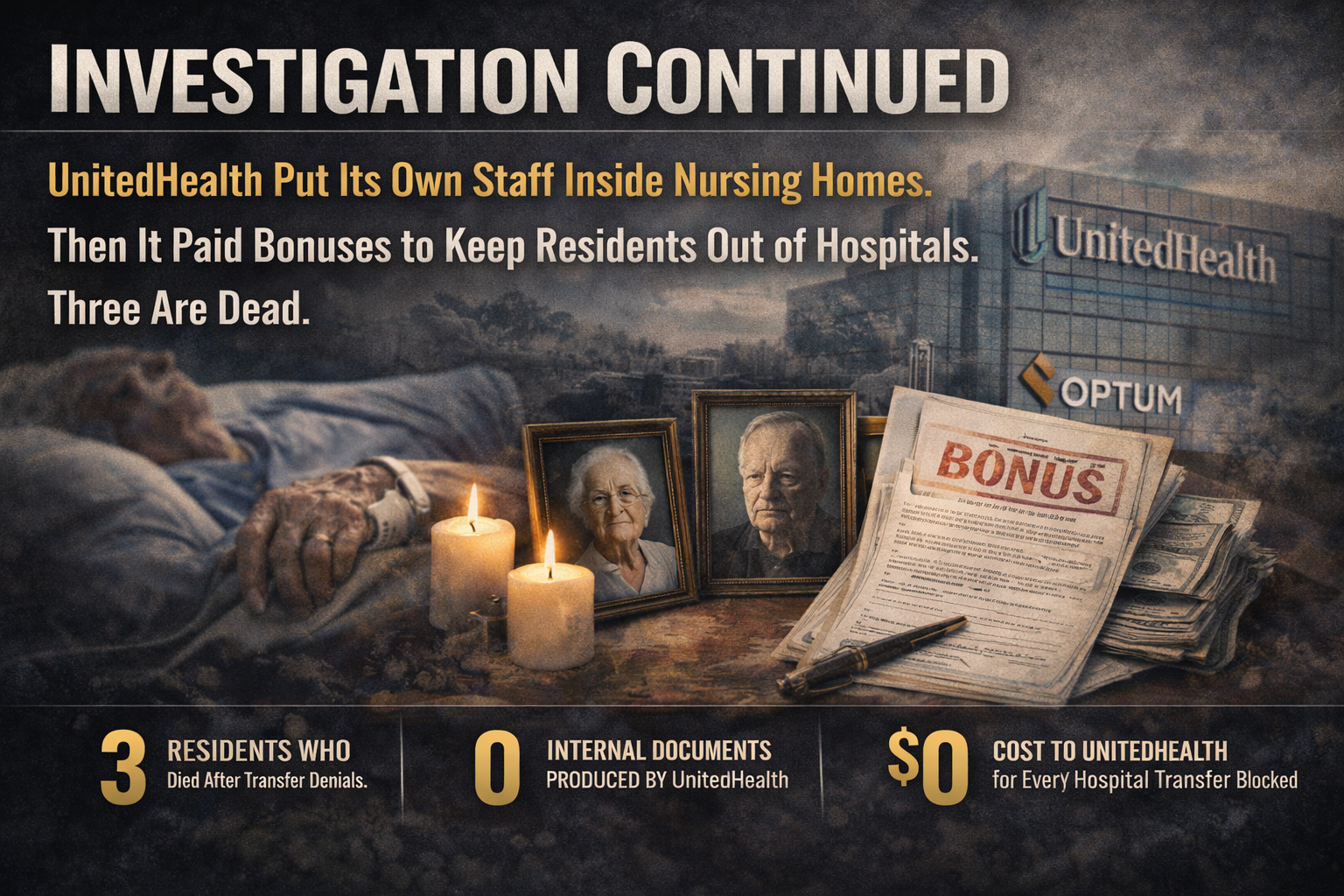
UnitedHealth Put Its Own Staff Inside Nursing Homes. Then It Paid Bonuses to Keep Residents Out of Hospitals. Three Are Dead.
Silent Voices first covered the Senate investigation into UnitedHealth on March 2. This is the deeper story. It is about a business model called the I-SNP, a bonus program that rewarded staff for avoiding hospital transfers, and three residents in Georgia, Ohio, and New York who died after those transfers were denied. It is also about what happened to the records afterward.
Understanding the I-SNP Model
To understand how this happened, you need to understand what an Institutional Special Needs Plan is. An I-SNP is a type of Medicare Advantage plan designed specifically for nursing home residents. UnitedHealth, through its subsidiary Optum, operates I-SNPs in facilities across the country.
Here is how the model works. Optum places its own employed medical staff, nurse practitioners and physicians, directly inside nursing homes. Those staff members are not employed by the facility. They work for Optum. Their job is to manage the care of residents enrolled in UnitedHealth’s Medicare Advantage plans.
Under Medicare Advantage, the federal government pays UnitedHealth a fixed monthly amount per enrolled resident. UnitedHealth keeps whatever is left after paying for care. Every hospital transfer that does not happen is money that stays inside UnitedHealth’s balance sheet.
Whistleblowers told investigators that Optum managers pressured their staff inside nursing homes to reduce hospitalizations. According to the Senate Finance Committee investigation, some staff members were offered bonus programs tied directly to how few residents they sent to the hospital.
The Three Cases
These are not abstractions. The Senate investigation identified at least three residents who died after hospital transfers were denied under the I-SNP model.
Age: 58. The resident showed seizure symptoms and was foaming at the mouth. A hospital transfer was requested. It was denied. The resident died hours later following the denial.
Age: 70. The resident sustained a traumatic head injury, was vomiting, and had low oxygen levels. A hospital transfer was requested. It was denied. The resident died in the room. The cause was determined to be internal bleeding.
Age: 63. The resident developed kidney failure. A hospital transfer was requested. It was denied. The resident died. Attorneys filed a wrongful death claim citing gross negligence.
The Senate Finance Committee has stated these may not be the only cases. Senators Wyden and Warren warned UnitedHealth directly that they consider these “shocking reports of seniors dying” and that they will use every available tool to get answers.
The DNR Coercion Allegation
The transfer denial pattern is only part of what whistleblowers have alleged. Investigators also received accounts that Optum employees were pressured into using advance directive planning as a tool to steer residents and families toward Do-Not-Resuscitate orders. A DNR, once in place, pre-empts the need for many expensive life-saving interventions, including hospital transfers.
If the allegation is accurate, it means the financial incentive to avoid hospitalizations extended beyond blocking individual transfer requests. It included shaping the legal documents that govern what care a resident receives for the rest of their life.
UnitedHealth has not confirmed or denied this allegation. It has not produced the internal documents the Senate requested. It has provided what senators described as “unsubstantial answers.”
What the Records Would Show
I review medical records for a living. When a hospital transfer is requested and denied, there is supposed to be documentation. The clinical reasoning for the denial. The name of the person who made the decision. The time it was made. The alternative care plan that was put in place.
The documents UnitedHealth is refusing to produce include its internal policies on hospitalization, the structure of its bonus programs, and communications between Optum managers and the staff placed inside these facilities. Those are exactly the documents that would show whether the denials were clinically justified or financially motivated.
Companies do not withhold documents that help their case. The Senate knows this. That is why they are pressing.
The Broader Market Picture
While families grieve and senators investigate, the skilled nursing sector is reporting record-high property sale prices and surging investor confidence. Companies like The Ensign Group recently increased dividends to shareholders. The money flowing out of these facilities to investors is moving in the opposite direction from the care flowing to residents.
UnitedHealth collected fixed federal payments for every enrolled nursing home resident. The less it spent on their care, the more it kept. That is not a side effect of the I-SNP model. That is the model.
If your loved one is enrolled in a Medicare Advantage I-SNP, ask: who employs the medical staff inside this facility? 1-800-677-1116 (Eldercare Locator)
File a Medicare Advantage complaint: Medicare.gov
Contact the Senate Finance Committee: finance.senate.gov
Wyden and Warren Demand Answers from UnitedHealth Group Following New Reports of Seniors Dying in Nursing Homes After Being Denied Care, Senate Finance Committee (February 2026): finance.senate.gov
Wyden and Warren Press UnitedHealth Group for Answers Following New Reports of Seniors Dying, Senator Warren Press Release (February 2026): warren.senate.gov
I-SNPs: Senators Increase Pressure on UnitedHealth, Cite Insufficient Response, LeadingAge (2026): leadingage.org
UnitedHealth Reduced Hospitalizations for Nursing Home Seniors. Now It Faces Wrongful Death Claims, The Guardian (December 2025): theguardian.com
Institutionalized Vulnerability: A Comprehensive Analysis of Systemic Neglect, Regulatory Rollbacks, and Enforcement Trends in the United States Nursing Home Sector (February 2026)


Leave a Reply