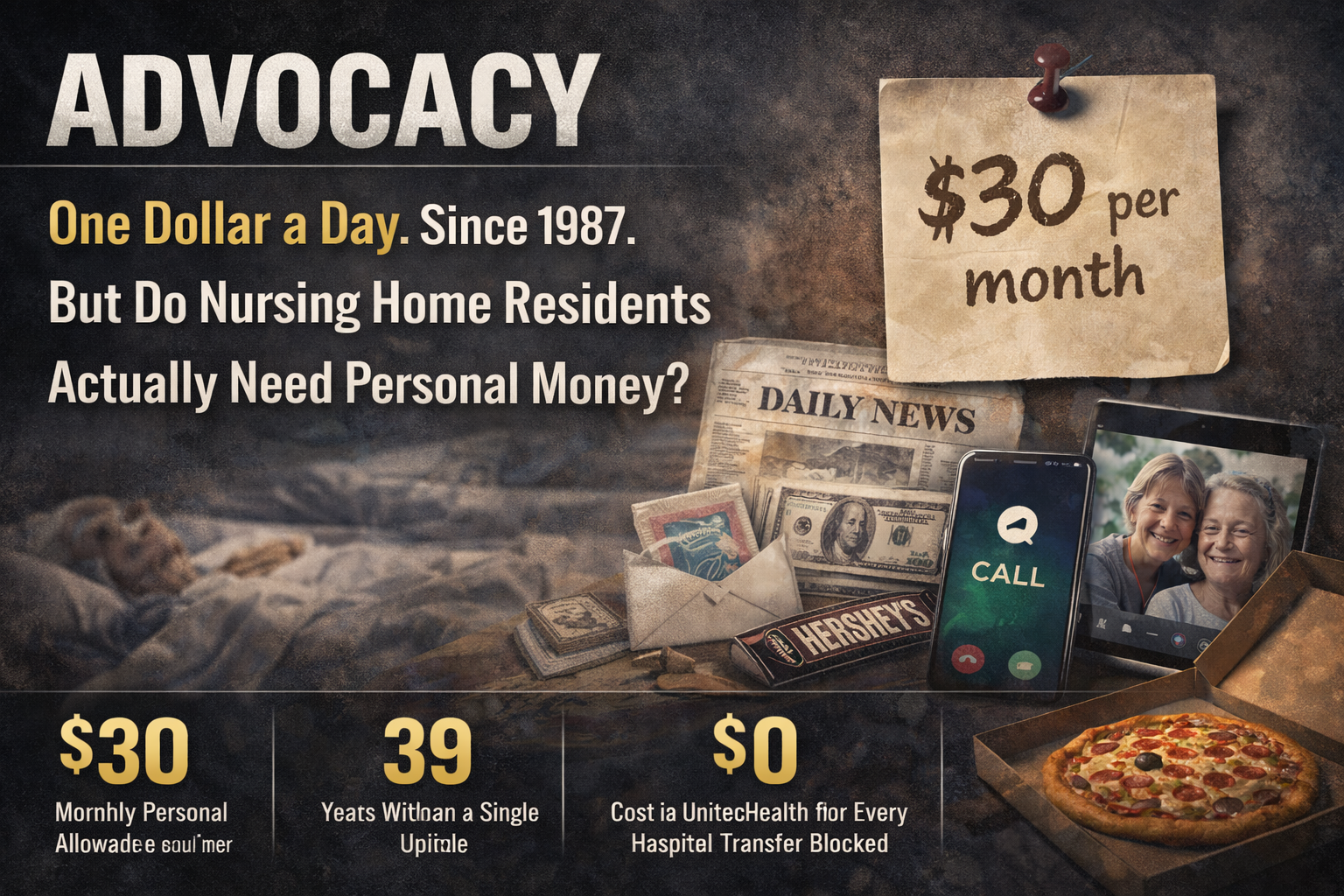
One Dollar a Day. Since 1987. But Do Nursing Home Residents Actually Need Personal Money?
Since 1987, Medicaid nursing home residents have received $30 a month in personal spending money. The facility provides their basic needs. So the question sounds simple: do they even need money? I worked as a CNA. I have reviewed medical records in elder abuse cases for years. The answer is more complicated than it looks, and it has changed dramatically since 1987.
First, Let’s Be Clear About What the Facility Covers
I worked as a CNA. I know what nursing homes actually provide. In the facilities I worked in, residents received toothpaste, soap, shampoo, lotion, towels, gowns, and blankets. Basic hygiene needs were covered. Meals were covered. A bed, a room, and medical care were covered.
So when we talk about the $30 monthly personal needs allowance, we are not talking about survival. We are not talking about a resident going without food or medication because they ran out of money. Medicaid covers those things.
We are talking about everything else. The things that make a person feel like a person and not just a patient.
Not All Facilities Are the Same
This conversation also changes depending on which type of facility we are talking about, and most people do not realize these are three very different environments with very different rules.
Federally regulated. Medicaid covers room, board, and basic care. The facility provides hygiene basics. The $30 personal needs allowance applies here because Medicaid takes nearly all of the resident’s income and leaves them that fixed amount.
State regulated, not federal. Coverage varies dramatically by state. Some states have Medicaid waiver programs for assisted living but what is covered and what the resident keeps differs from state to state. Many residents pay privately, which means more personal funds but also more financial exposure.
Essentially senior apartments. No medical care provided. Residents manage their own finances entirely. The $30 SSI allowance does not apply here. These residents have more money but also less institutional oversight, making them among the most targeted by financial predators.
The $30 allowance is specifically a skilled nursing facility issue tied to Medicaid. But the broader question of financial access and financial vulnerability applies across all three settings, just in different ways.
What the $30 Actually Gets Used For
In a skilled nursing facility in 1987, a resident might use their $30 for a newspaper, a candy bar from the vending machine, a birthday card to mail to a grandchild, or a specific brand of perfume the facility did not stock.
Those needs still exist in 2026. Residents still want snacks. Some use DoorDash. Some want their preferred brand of lotion because the facility-issued one irritates their skin. Some want to tip a staff member who went out of their way for them. Small things. Personal things. Things that remind them they still have preferences and choices.
But 2026 looks nothing like 1987 in one very important way.
In 1987, a nursing home resident needed money for vending machines and birthday cards. In 2026, they need money for a phone plan, a tablet, streaming services, and app-based food delivery. The world moved. The allowance did not.
1987 Versus 2026: The World These Residents Are Living In
- Newspaper or magazine subscription
- Vending machine snacks
- Greeting cards and stamps
- Personal brand toiletries
- Pay phone calls to family
- Small personal items
- Cell phone or tablet and data plan
- Video calling apps to see family
- Streaming services for entertainment
- Food delivery apps like DoorDash
- Digital subscriptions and services
- App-based purchases and transactions
Residents who have phones and tablets are connected to their families in ways that were not possible in 1987. A grandmother who cannot leave her bed can still watch her grandchild’s school play over video call. A resident with dementia can still hear a familiar voice every evening. That connection has real clinical value. Isolation accelerates cognitive decline. Connection slows it.
But a phone plan costs money. A tablet costs money. And $30 a month does not cover any of it.
The Other Side of Digital Access: Vulnerability
Here is where the story gets darker.
Every device that connects a resident to their family also connects them to every scammer who targets seniors online. Phishing texts. Fake Medicare calls. Romance scams. Grandparent scams where someone calls pretending to be a grandchild in trouble and needing money wired immediately.
In 1987, a nursing home resident’s financial exposure was limited. There was not much money and not many ways to access it remotely. In 2026, a resident with a smartphone, a bank app, and $30 in a facility account is a target. They may have cognitive decline that makes them more susceptible. They may not have family checking in regularly. They may not know how to identify a scam. And the facility is not responsible for monitoring their digital activity.
We gave residents access to the digital world without giving them the tools, the funds, or the protection to navigate it safely. That is not progress. That is a new form of exposure layered on top of an old one.
The Two Realities: Families Who Show Up and Residents Who Have No One
Here is something that rarely gets talked about in policy discussions. The $30 personal needs allowance lands very differently depending on whether a resident has family involved in their care.
For residents with engaged families, the $30 is almost beside the point. Family members bring extra blankets, favorite foods from a restaurant they loved for 40 years, new clothes that actually fit, books, magazines, audiobooks. They bring birthdays and holidays and Sunday visits and all the things that money buys but that are really about presence and love. The $30 sits in a facility account and maybe covers a candy bar or two while the family covers everything that actually matters to that person’s quality of life.
For residents with dementia, cognitive decline, or physical limitations who cannot manage money themselves, a family member or legal guardian typically serves as their representative payee. They make spending decisions on the resident’s behalf. They decide what gets bought, what gets prioritized, what small comfort gets delivered on a Tuesday afternoon because they know it will make their person smile.
But what about the resident who has no one? No children. No spouse. No family member who calls, visits, or brings anything. For that resident, the $30 is not a supplement to family care. It is the entire picture. It is everything they have in the world that belongs to them alone.
And when that resident also has dementia and cannot manage their own account, the facility becomes the default manager of their funds. That is the scenario where financial exploitation is most likely to occur. No family watching. No one reviewing the statements. No one asking questions. Just a vulnerable person and a system that is supposed to protect them but is not always equipped or motivated to do so.
The Modernize SSI Stipends Act
On February 13, 2026, a bill was introduced to raise the personal needs allowance from $30 to $60. The first update in 39 years. Two dollars a day instead of one.
Will $60 cover a phone plan? No. Will it cover a tablet? No. Will it meaningfully change the digital vulnerability these residents face? Not on its own. But it is an acknowledgment that the number should at least attempt to reflect the world as it exists today. And it opens a conversation that has been closed since 1987.
What that conversation needs to include is not just the dollar amount. It needs to include what facilities are responsible for providing in 2026 versus what they provided in 1987. It needs to include digital literacy support for residents. It needs to include financial monitoring protections that account for the fact that theft and scams now happen through a screen, not just through a forged check.
So Do They Really Need Money?
Ask the facility administrator and they will tell you the basics are covered.
Ask the resident who wants to order a pizza on Friday night because that was their tradition for 30 years and they have $2.47 left in their account.
Ask the resident who got a text saying their bank account was compromised and clicked the link because no one taught them not to and now their $30 is gone.
Ask the resident whose family lives three states away and who uses a tablet to video call their grandchildren every Sunday, paid for by a daughter who is already stretched thin.
Ask the resident in assisted living who is managing their own finances, paying their own bills, and just received a call from someone claiming to be from Medicare asking for their account number.
The question is not really about money. It is about what kind of life we think these people are entitled to, and who is responsible for protecting it.
Stealing from a nursing home resident, taking their money, misusing their account, or pressuring them to hand over funds is financial abuse. It is a crime. It happens more than most people know and it is vastly underreported.
If you know or suspect that someone is being financially abused or neglected, report it. You do not need proof. You do not need to be certain. You just need to say something. Not sure where to start? Visit our Resources page.
Contact your representative about the Modernize SSI Stipends Act: congress.gov
National Consumer Voice for Quality Long-Term Care: theconsumervoice.org
Eldercare Locator: 1-800-677-1116
National Elder Fraud Hotline: 1-833-FRAUD-11 (1-833-372-8311)
The Voice: February 17, 2026, National Consumer Voice for Quality Long-Term Care: theconsumervoice.org
Modernize SSI Stipends Act, introduced February 13, 2026: Referenced in Consumer Voice and Senate Finance Committee reporting
Supplemental Security Income Personal Needs Allowance, Social Security Administration: ssa.gov
Institutionalized Vulnerability: A Comprehensive Analysis of Systemic Neglect, Regulatory Rollbacks, and Enforcement Trends in the United States Nursing Home Sector (February 2026)
Silent Voices prior reporting: The $4.8 Million Donation, March 1, 2026: nathaliefrias.net



Leave a Reply