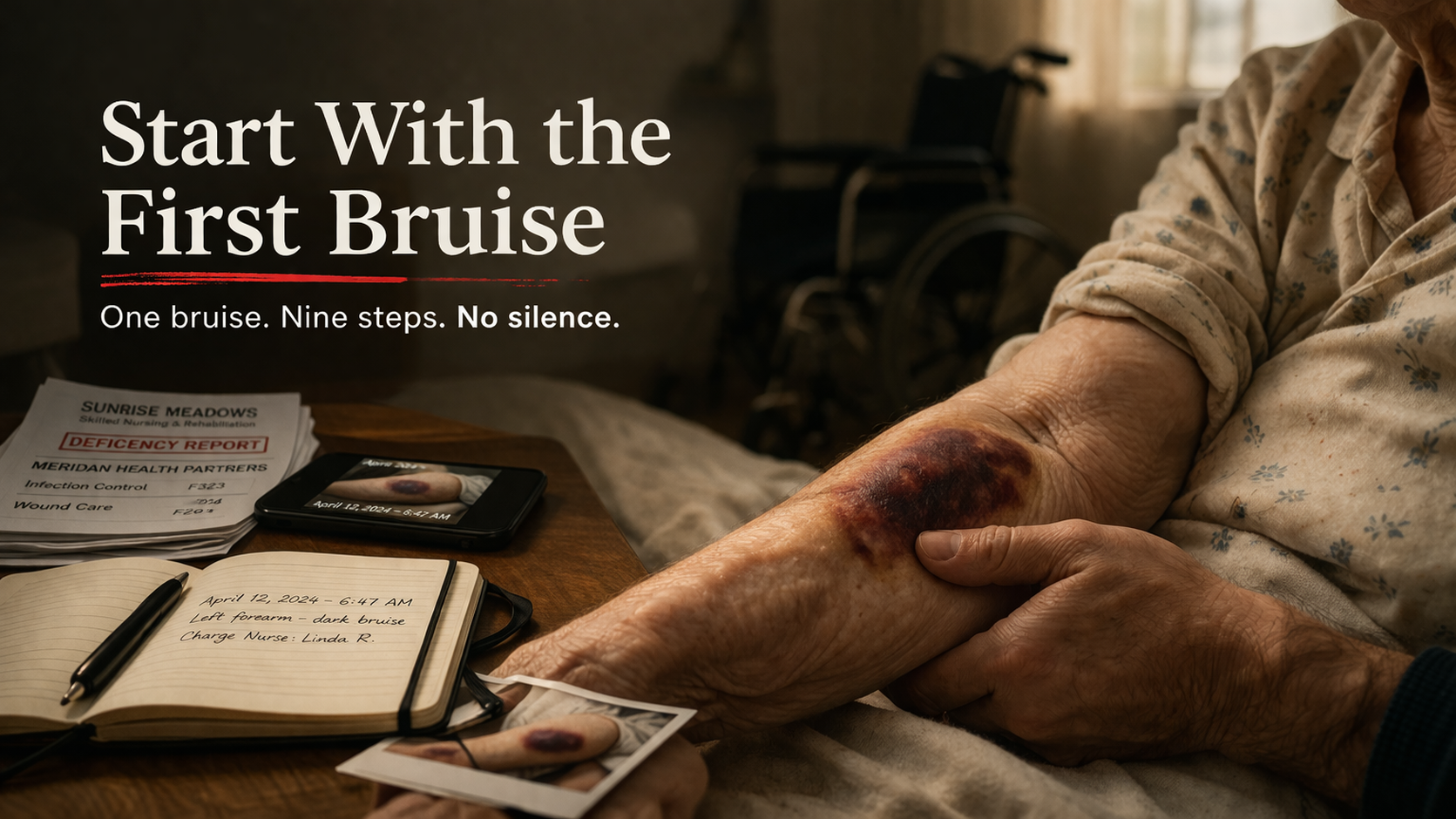
One bruise. Nine steps. No silence.
Whitmore County, Arkansas
The first bruise appeared on a Tuesday.
Marcus Hayes found it on his wife’s left forearm while helping her adjust the blanket she always kicked off in her sleep. A dark oval, the size of a thumbprint, pressed into skin that had grown thin and pale in the four months since Sunrise Meadows became her address.
“She probably bumped it on the bedrail,” the charge nurse said without looking up from her clipboard.
Marcus didn’t argue. He took a photo. Then another. He turned on the timestamp setting and photographed both arms, her legs, the back of her neck. He wrote the date, the time, and the nurse’s name in the small notebook he now carried in his jacket pocket.
He did not know yet that this was Step One.
Step Two came by Thursday. He requested Diane’s full medical record. The woman at the front desk told him the process took thirty days. Marcus placed the request in writing, handed it to the administrator, and kept the copy. He sat in his truck in the parking lot and searched “medical record request rights” until he found the federal law that said they had to give it to him. He printed the statute at the public library and brought it back the next morning. They gave him the records in nine days.
The wound care log said “skin tear, resolved.” The photo on his phone said otherwise.
Step Three started on a Saturday morning from his kitchen table. He filed a complaint with the Long-Term Care Ombudsman. He called the Eldercare Locator and spoke to a woman who gave him two more numbers. He reported the bruise to Adult Protective Services. He filled out the online complaint form for the state health department. Each call took less than fifteen minutes. Each one created a paper trail that Sunrise Meadows did not control.
He checked the facility’s inspection history on Medicare Care Compare that same weekend. Sunrise Meadows, owned and operated by Meridian Health Partners, had been cited for infection control failures, insufficient staffing, and improper wound care documentation in three consecutive surveys. The pattern was there. He printed every page.
Then he went deeper. He searched ProPublica’s Nursing Home Inspect database and found the same citations repeated across two other Meridian Health Partners facilities in Whitmore County. Brookfield Manor. Pinecrest. The same language in the deficiency reports. The same corrective action plans filed and never followed. The same cycle.
Three facilities. Three counties. One owner. The same failures written in the same language, filed by the same consultants, corrected by no one.
The following Monday, the facility social worker sat Marcus down and suggested that Diane might benefit from hospice services. “She’s declining,” the social worker said. “Hospice would make her more comfortable.” Marcus asked what specific medical criteria supported the recommendation. The social worker did not have an answer. He declined in writing and requested a care conference with the attending physician.
Diane was not dying. Diane had a Stage 2 pressure ulcer that no one had treated. If Marcus had signed the hospice consent, curative treatment would have stopped. The wound would have grown. The facility would have documented her decline as natural. And no one would have looked at the chart again.
Step Seven. A nursing home abuse attorney took his call on a Wednesday. The consultation was free. Marcus brought the medical records, the photos, the inspection reports, the complaint confirmations, and the notebook. The attorney opened the wound care log to the entry that read “skin tear, resolved,” then placed the photo of Diane’s forearm beside it. A Stage 2 pressure ulcer documented as a skin tear. A chart that said “resolved” while the wound was still open. The attorney took the case before Marcus finished his coffee.
Marcus learned his rights in the weeks that followed. He had the right to visit Diane at any hour. He had the right to participate in her care plan. He had the right to contact the Ombudsman without retaliation. He had the right to request a transfer. He exercised every single one.
Diane came home eleven weeks after the first bruise.
Not everyone does.
In Whitmore County alone, families exposed to the same failures at Meridian Health Partners facilities have buried loved ones whose records told a different story than the truth. Families who did not know they had the right to request the chart. Families who believed the social worker when she said hospice was the only option. Families who never checked the inspection history.
Marcus Hayes did not have special training. He did not have a medical background. He had a phone, a notebook, and the refusal to believe that a bruise the size of a thumbprint was nothing.
If this story feels familiar, start here →
Start with the first step: document everything.
Keep Reading
Investigation How Nursing Homes Hide Neglect in Medical Records Investigation How Nursing Homes Suppress Incident Reports Investigation When Neglect Becomes a Crime: Criminal Charges in Nursing Homes Resource Signs of Nursing Home Abuse and Neglect Resource CMS Nursing Home Watchlist Resource Nursing Home Abuse Law Firm Directory

Leave a Reply