
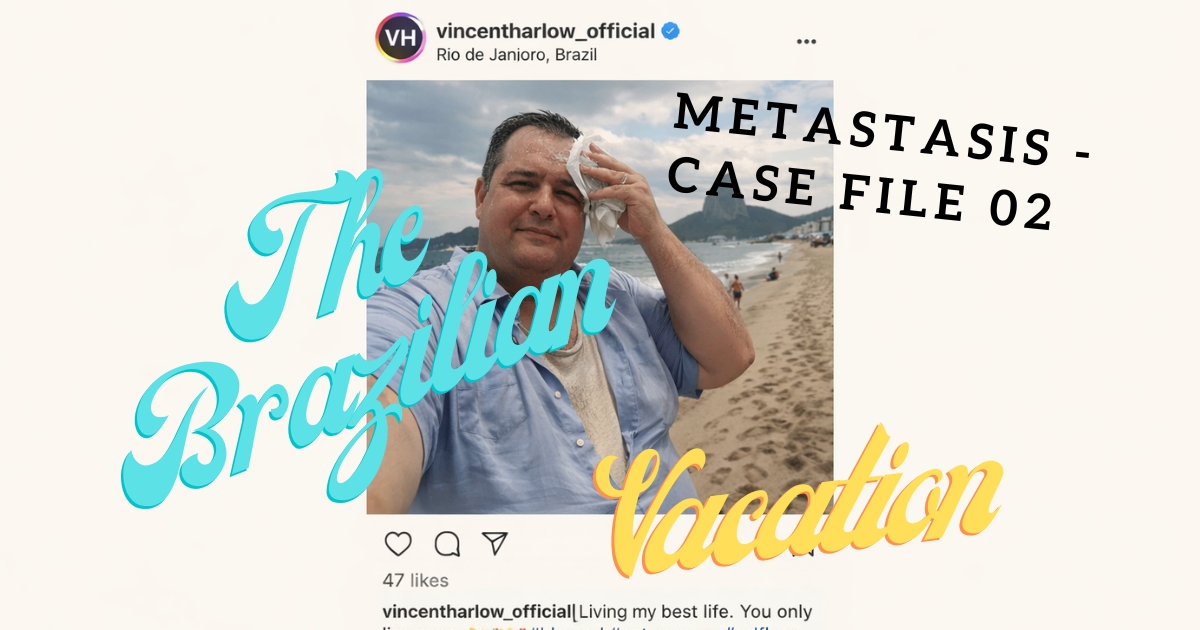
Vincent Harlow was living his best life.
He posted about it three times a day, which is how Anastasia Mercer would eventually find him, but Vincent didn’t think about things like digital footprints or federal subpoenas when he was on his fourth caipirinha before noon. Vincent didn’t think about most things. That was his gift. The ability to stand in the wreckage of other people’s lives and feel absolutely nothing except the warmth of the sun on his face and the cold of the glass in his hand.
He was fifty-three years old, five foot seven, two hundred and sixty pounds, stuffed into shirts meant for a man fifty pounds lighter. The buttons strained. One was always missing. A yellowed undershirt showed through the gaps. He sweated constantly, even in air conditioning, and dabbed his forehead with a handkerchief he believed looked distinguished. It looked like a surrender flag.
beachvibes_rio 🔥🔥🔥
View all 3 comments
Three thousand miles north, in a town called Paradise Falls in Whitmore County, seven elderly residents sat in a building called Palmetto House and waited for someone to feed them.
Palmetto House was a Community Residential Care Facility, which sounded official and medical but was a twelve-bed assisted living home in a converted ranch house on Magnolia Street. The building had been a private residence until 2019, when Meridian Health Partners acquired the property, applied for a state license, and installed Vincent Harlow as administrator. The installation process consisted of giving Vincent a set of keys, a state-issued certificate of authority, and a monthly operations budget that he treated as a personal ATM.
The facility smelled. Not the way hospitals smell, antiseptic and clinical. Palmetto House smelled like a problem that had been sprayed with air freshener and closed behind a door. The carpets held years of accidents nobody had cleaned properly. The kitchen held food that had expired on a schedule no one tracked. The residents held whatever dignity they could manage in a building where the call lights hadn’t worked since October.
Vincent had left for Brazil on October 14. Two months ago. He told the staff he was attending a “healthcare leadership conference in South America.” There was no conference. He told Destiny, the sole remaining caregiver, that he would be back in two weeks. He told himself that everything would be fine. He told nobody that the other three staff members had quit in September because he’d stopped paying them.
He blocked the facility’s phone number on November 3, after Destiny’s fourteenth text. She “talked too much” and “couldn’t handle things on her own.” He said this from a poolside cabana while a waiter brought him his sixth drink of the afternoon.
Destiny sent forty-seven texts over two months. Vincent read fourteen of them. He responded to zero.
Destiny Williams was twenty-two years old. Sweet face. Nervous smile. She said “yes sir” and “I’m so sorry” the way people say them when they’ve learned that smallness is a survival strategy. She had no CNA certification, no medical training, no background in elder care. Vincent had hired her four months before he left, and the interview had lasted less time than his average lunch. She was young. She was cheap. She didn’t ask questions. That was Vincent’s hiring criteria, and Destiny met all three requirements.
Or so he believed.
From the outside, the story was clear. A predator administrator abandoned a vulnerable facility to vacation in Brazil. An untrained twenty-two-year-old girl was left alone with seven residents she didn’t know how to care for. People suffered. One person died. The system failed again, the way systems always fail, from the top down, crushing the people at the bottom.
That was the story the news would tell. That was the story Anastasia Mercer would investigate. That was the story the jury would hear.
The story was wrong.
Not about Vincent. Vincent was everything he appeared to be: a sweating, self-deluded, negligent predator who hired young women and called it mentorship, who treated elderly residents as billing units and their care as someone else’s problem.
The story was wrong about Destiny.
But nobody would figure that out until it was far too late.
Leave a Reply