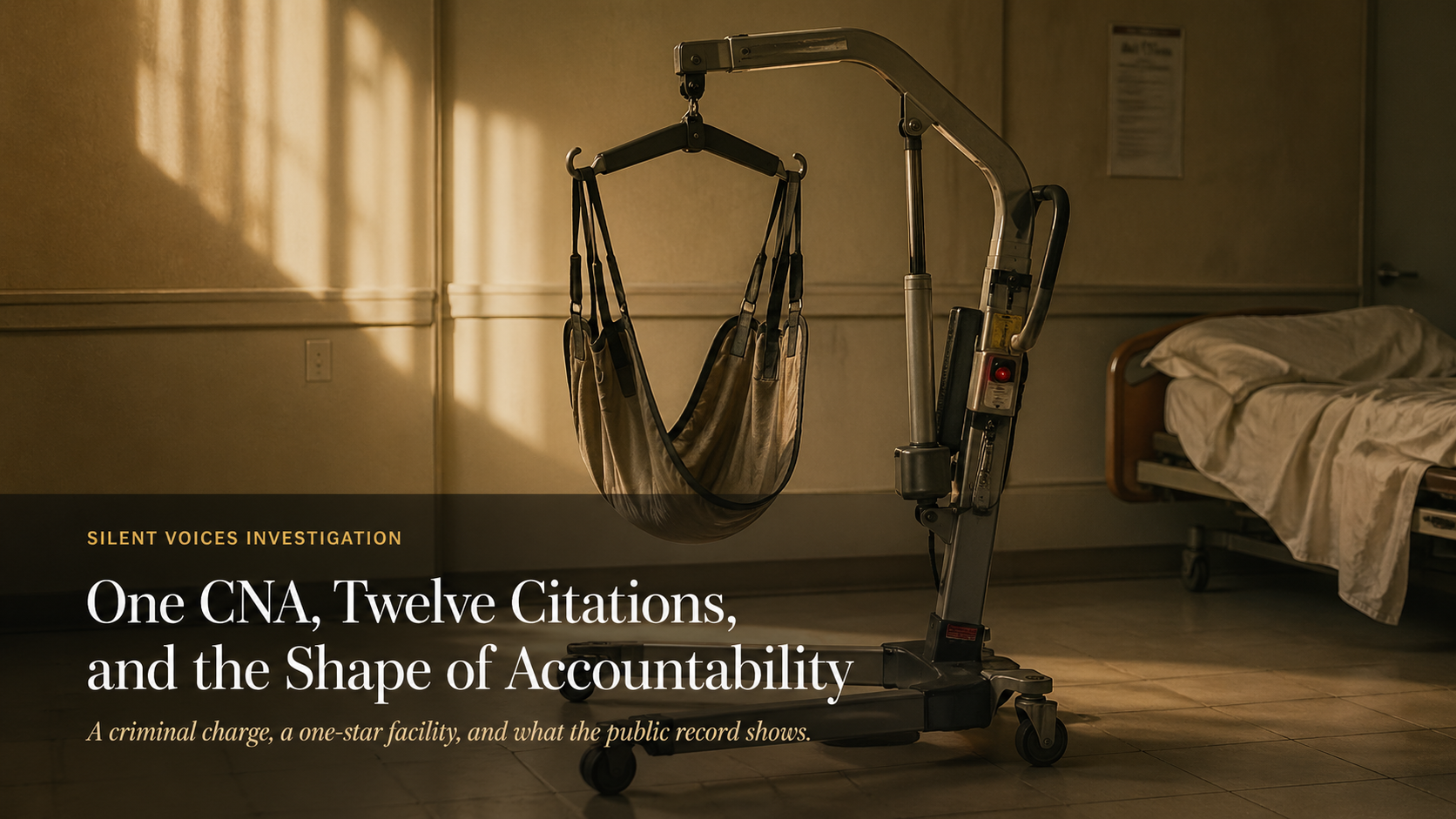
A criminal charge, a one-star facility, and what the public record shows.
A certified nursing assistant in Baton Rouge is sitting in a Louisiana parish jail. She was indicted by a grand jury on October 2, 2025, on a charge of negligent homicide. The patient she was caring for at Jefferson Manor Nursing and Rehabilitation Center died in June 2024 after slipping out of a hydraulic lift sling and landing on the feet of the lift. The autopsy listed the cause of death as complications from blunt force injuries.
According to the press release issued by Louisiana Attorney General Liz Murrill, the CNA, Diamond Johnson, “operated a hydraulic lift by herself.”
That single phrase anchors the criminal case. It is also the sentence that pulled this story onto my desk.
I want to say this plainly before we go any further. I am not an investigative journalist. I am not reporting new facts. The criminal case against Diamond Johnson is active, and the grand jury record is sealed. The public record stops there. What is publicly available is what the Food and Drug Administration recommends about hydraulic lift operation, what the manufacturers themselves publish, and what the Centers for Medicare & Medicaid Services has documented about Jefferson Manor as a facility.
From a records review perspective, that public information raises a question. When a frontline worker is criminally charged for an action that occurred inside a facility with this documented record, where is responsibility actually being placed, and where should it be?
The Case as Presented
What the Attorney General Released
Diamond Johnson, age 24, of Zachary, Louisiana, worked as a certified nursing assistant at Jefferson Manor Nursing and Rehabilitation Center in Baton Rouge. On June 14, 2024, she attempted to transfer a female patient from a chair to her bed using a hydraulic lift with a sling. The patient slipped out of the side of the sling and landed on the feet of the lift. The patient became unresponsive approximately forty minutes later. Resuscitation efforts were unsuccessful.
The investigation was conducted by Attorney General Murrill’s Medicaid Fraud Control Unit. The grand jury indicted Johnson on October 2, 2025. She was booked into the East Baton Rouge Parish Prison. According to reporting by WAFB, the AG’s statement framed the indictment as protecting vulnerable citizens from negligence.
“My job as attorney general is to protect the citizens of this state, especially those who can’t protect themselves,” Murrill said in a statement. “The grand jury felt, as we did, that Ms. Johnson was negligent in the care she provided to the victim, who unfortunately lost her life as a result of that negligence.”
The press release stated that Johnson operated the lift by herself. That detail led most news coverage, because it is the detail that frames the case. One CNA. Alone. With a hydraulic lift. A patient died.
What the press release did not address is whether Jefferson Manor had a policy requiring two-person transfers, what the resident’s individual care plan specified, what the staffing levels on the floor were that day, or what training Johnson had received on that specific lift. None of those facts have been released publicly. Some of the most important documentation in cases like this sits in the facility’s incident report system, which families and the public rarely see in full. I have written about how facilities suppress those reports, and what that suppression means for accountability when something goes wrong.
From a records review perspective, those are the questions that determine where responsibility actually lives. And on those questions, the public record outside the criminal case has something to say.
Federal Safety Guidance
Two or More Caregivers
The Food and Drug Administration publishes a document called the Patient Lifts Safety Guide. It is a federal publication addressing the question this case raises.
Under the section titled “Prepare Environment,” the guide states a simple instruction.
“Most lifts require two or more caregivers to safely operate lift and handle patient.”
That sentence is federal safety guidance on lift operation, in the FDA’s own words. It is not buried in technical literature. It appears on the page that explains how to set up a transfer.
Manufacturer instructions reflect the same standard. Joerns Healthcare, the maker of the Hoyer brand, states in its user manual that “a minimum of two caregivers is recommended for safe operation”. One caregiver operates the lift while the second supports the resident and prevents them from slipping out of the sling. Independent caregiver education resources, including those published by state-level respite organizations, repeat the same guidance.
There is no single federal law that says “two people must operate a Hoyer lift.” The standard exists in three places at once. It is in the FDA’s published safety guide. It is in the manufacturer’s instructions for use. And in skilled nursing facilities, it is enforced through the federal regulation at 42 CFR 483.25(d), known to inspectors as F-Tag F689, which requires facilities to keep residents free of accident hazards, provide adequate supervision, and ensure assistive devices are used properly and according to manufacturer specifications.
In the language of the federal regulation, an assistive device that is used “without adequate supervision when needed” or “not used according to manufacturer’s specifications” is itself a hazard the facility is required to prevent. F689 has been the most-cited Immediate Jeopardy citation in recent years.
From a records review perspective, when a CNA performs a hydraulic lift transfer alone, the federal framework places primary responsibility for accident prevention on the facility. Did the facility have a policy aligning with FDA guidance and manufacturer instructions? Did the resident’s care plan specify the number of staff required? Were enough staff scheduled that day for that policy to be followed?
The answers to those questions are not in the AG’s press release. They would be in the inspection reports, the staffing records, and the care plan documentation. Some of that is publicly available. Some of it is not.
What is publicly available is the facility’s documented track record.
Jefferson Manor on the Public Record
Twelve Citations and an Abuse Flag
Jefferson Manor Nursing and Rehab Ctr, LLC is a 122-bed for-profit skilled nursing facility at 9919 Jefferson Highway in Baton Rouge. It is part of a chain operated under Central Management Company. It participates in Medicare and Medicaid. It is regulated by CMS under federal certification number 195471.
On the official Medicare.gov Care Compare profile, Jefferson Manor displays a one-star overall rating. The maximum is five stars. The facility’s name on the public profile is also accompanied by a red icon. CMS uses that icon to flag facilities cited for potential issues related to abuse.
The most recent standard health inspection took place on February 27, 2025. It produced twelve health citations. The national average for that type of inspection is 9.5. The Louisiana average is 8.3. Jefferson Manor exceeded both.
In the past year, the facility has also been the subject of three separate complaint inspections, on March 10, May 21, and September 4 of 2025. Complaint inspections are triggered by reports submitted by residents, families, or other parties. The fact that three were conducted at this facility in twelve months indicates a pattern of concerns serious enough to warrant repeated state visits.
The federal fines
Jefferson Manor has received three federal fines in the past three years, totaling $121,628. The dates and amounts tell their own story.
The first fine, $16,276, was imposed on June 27, 2024. That is less than two weeks after the patient died on June 14, 2024.
The second fine, $25,590, was imposed on December 26, 2024.
The third fine, $79,762, was imposed on February 27, 2025, the same date as the most recent standard inspection.
The fines are escalating, not decreasing.
The staffing data
CMS publishes detailed staffing data for every certified nursing facility, derived from payroll-based journal reports submitted by the facilities themselves. Jefferson Manor’s numbers are public.
Registered nurse hours per resident per day at Jefferson Manor: 20 minutes. The national average is 41 minutes. Jefferson Manor provides less than half the national average of registered nurse time per resident per day.
Registered nurse hours per resident per day on weekends: 15 minutes. The national average is 28 minutes.
Total nurse staff hours per resident per day: 3 hours and 52 minutes, near the national average. So the total time looks adequate. But the breakdown shows the facility leans heavily on certified nurse aides and licensed practical nurses to fill the hours, rather than registered nurses. From a records review perspective, this is a documented skill-mix substitution pattern. The total hours number stays close to the average. The clinical oversight that registered nurses provide does not.
The clinical outcome data
CMS also publishes clinical quality measures derived from resident assessments. Jefferson Manor’s measures, compared to national averages, point to specific patterns.
Pressure ulcers, new or worsened in short-stay residents: 7.40 percent. National average: 2.29 percent. More than three times the national rate.
Long-stay residents experiencing falls with major injury: 5.1 percent. National average: 3.3 percent. Louisiana average: 3.4 percent.
Hospitalizations per 1,000 long-stay resident days: 4.06. National average: 1.89. More than double the national rate.
Short-stay residents re-hospitalized after a nursing home admission: 42.1 percent. National average: 23.9 percent.
Long-stay residents who lost too much weight: 10.3 percent. National average: 5.4 percent. Nearly double.
Healthcare personnel who got a flu shot for the current season: 13.13 percent. National average: 42 percent.
Healthcare personnel up to date with COVID-19 vaccines: 0 percent. National average: 8.20 percent.
From a records review perspective, this is what facility-level outcomes look like when clinical oversight is structurally constrained. Pressure ulcers above the national rate point to gaps in turning, repositioning, and skin assessments. Falls with major injury above the state and national rate point to gaps in supervision and transfer protocols. Hospitalization rates above the national average point to gaps in early intervention. The numbers do not prove what happened in any individual case. They document the pattern within which individual cases occur.
The Question the Record Raises
Where Does Responsibility Live?
Set the two records side by side.
On one side, a 24-year-old certified nursing assistant. Indicted for negligent homicide. Sitting in a parish jail. Named in every news report. Her face on the East Baton Rouge Parish Sheriff’s Office booking page. The press release frames the case as a single individual’s negligent action.
On the other side, a 122-bed for-profit nursing facility. One-star overall rating. Abuse-flag icon. Twelve health citations on the most recent inspection. Three complaint inspections in twelve months. $121,628 in escalating federal fines, the first arriving less than two weeks after the patient died. Registered nurse staffing at less than half the national average. Pressure ulcer rates more than three times the national average. Hospitalization rates more than double the national average. Healthcare personnel vaccination compliance at 13 percent for flu and zero percent for COVID-19. The facility continues to operate.
One CNA is in jail. The facility is open for business.
From a records review perspective, this asymmetry is the question. The grand jury saw evidence the public has not seen, and the facts of Diamond Johnson’s specific actions on June 14, 2024 are not yet public. She may have made an error in judgment. The piece does not absolve her.
What the public record does show is that nursing home harm is almost never produced by a single frontline worker acting in isolation. It is produced by the conditions on the floor that day, which are produced by the staffing schedule, which is produced by the budget, which is produced by the corporate structure, which is regulated by federal rules, which are enforced by inspections that result in citations and fines that the facility absorbs and continues operating. I have written about this chain of neglect before, and the Jefferson Manor record is a textbook example of how each link in that chain produces the next.
When a CNA is criminally charged in isolation from the facility-level documentation that surrounds the incident, the question the public record raises is whether accountability is being distributed in a way that matches where responsibility actually lives.
What I See When I Read These Records
The Chart Around the Chart
In medical records review, when you are asked to read a chart, you do not just read the chart. You read the chart around the chart.
The chart in front of you is the resident’s. The orders, the assessments, the medication records, the wound notes, the transfer documentation. But every entry on every page was produced inside a facility, on a shift, by a person who was either supervised or not, trained or not, supported or not. The chart never stands alone. It is always surrounded by the conditions under which it was created.
When I read a chart from a facility with one-star ratings, an abuse flag, escalating fines, and registered nurse staffing at less than half the national average, I am reading a document produced inside a documented pattern of clinical underperformance. That does not tell me what happened in any specific incident. It does tell me what conditions were present in the room.
A hydraulic lift transfer is a high-risk procedure. The FDA recommends two caregivers. The manufacturer specifies two caregivers. The clinical algorithms used in skilled nursing direct two caregivers for residents who are not fully cooperative. The federal accident prevention regulation requires facilities to provide adequate supervision and use assistive devices according to manufacturer specifications. None of those documents assign responsibility solely to the individual aide who picks up the lift.
When the AG’s press release says the CNA “operated a hydraulic lift by herself,” the public record outside the criminal case raises a parallel question. Why was she alone with that lift? What did the staffing schedule show? What did the resident’s care plan specify? What did the facility’s policy require? What did the facility’s training program cover?
A patient died at Jefferson Manor. A young woman is in jail. The facility is open for business with the same one-star rating, the same abuse flag, and the same registered nurse staffing problem it had on the day the patient died. Whatever the criminal case ultimately decides about Diamond Johnson, the public record about the facility around her remains the public record.
Accountability describes where responsibility sits. In nursing home harm, responsibility almost always sits in more than one place at once. Frontline workers, supervisors, administrators, owners, regulators, and the corporate structures that hold them all together. When the chain of responsibility narrows to a single CNA, the question the public record raises is whether the rest of the chain has been examined at all.
That is the question this case puts on the table.
A Word to the People Doing This Work
To the CNAs Reading This
If you are a certified nursing assistant, a licensed practical nurse, a registered nurse, or any other healthcare worker who uses hydraulic lifts and other transfer equipment in your daily work, this last part is for you.
You are not expected to work in fear. If you follow the equipment instructions, follow your facility’s policy, and follow the resident’s care plan, you are doing your job correctly. The standards exist to protect you and the resident at the same time. The FDA guidance, the manufacturer’s instructions, and the facility’s own training program are tools you have the right to use and the right to insist on.
You also have the right to refuse an unsafe assignment under facility policy and safety standards. If the second caregiver is not available, if you have not been trained on the specific equipment in front of you, or if you see a risk that is not being addressed, you can speak up. You can document. You can ask for help. Your safety and the resident’s safety come first, and the documentation that you raised the concern is part of the record that protects everyone in the room.
The system you work in often does not support those decisions. Short staffing, time pressure, and fear of pushback are real. None of those pressures change what the FDA recommends, what the manufacturer specifies, or what your license requires you to know. When the conditions on the floor make safe practice impossible, that is documentation the facility has to answer for.
You are not alone in this work, and you are not the only line of defense. The standards exist for a reason. Use them. Insist on them. They are written to protect you.
Sources and Resources
Read the Documents. Check the Records.
Everything cited in this post comes from publicly available federal and state records. Here is where to find it.
FDA and federal guidance
· FDA Patient Lifts Safety Guide (the published federal guidance referenced throughout this post)
· 42 CFR Part 483 Requirements for Long Term Care Facilities (federal regulation including F-Tag F689 on accident prevention)
Jefferson Manor public record
· Medicare.gov Care Compare profile for Jefferson Manor (CMS rating, citations, fines, staffing data, and clinical measures)
· ProPublica Nursing Home Inspect (the same federal data, easier to navigate)
Reporting on the Diamond Johnson indictment
· WAFB: Former nursing assistant in BR indicted for negligent homicide
· The Advocate: Former Baton Rouge nurse indicted for negligent homicide
· Law & Crime: Nursing home worker killed patient while trying to operate hydraulic lift by herself
More from Silent Voices
· The Chain of Neglect — how the system fails residents and the caregivers who serve them
· How Nursing Homes Suppress Incident Reports — what facilities document and what they hide
· This Is What Neglect Looks Like — the cases that prove it
· Your Silence Is a Choice — on accountability and the obligation to speak
· Nursing Home Safety Rating — how to read the CMS star ratings
If this story feels familiar — if you have a loved one in long-term care, or if you work in a facility and recognize the patterns described above — you are not alone, and you are not imagining it. Silent Voices exists because the chart around the chart almost always tells a story the headlines do not.
Discover more from Silent Voices by Nathalie Frias
Subscribe to get the latest posts sent to your email.


Leave a Reply