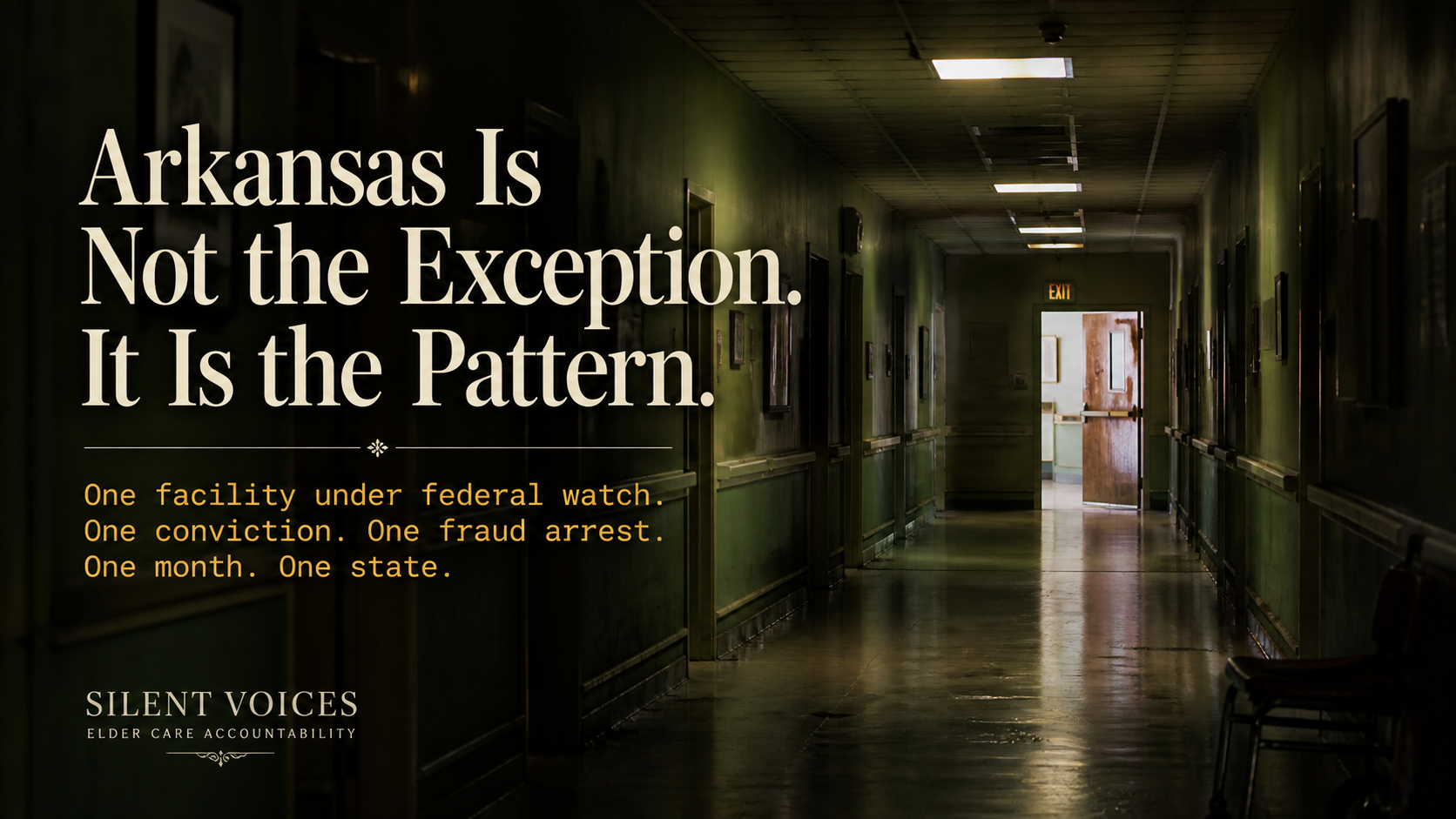
As of April 29, 2026, one Arkansas nursing home remains under federal Special Focus Facility monitoring. That single fact opens a window into a system operating under simultaneous pressure from every direction.
Three things happened in Arkansas in April 2026. A nursing home stayed on a federal watch list. A caregiver was convicted of striking a resident with dementia. A personal care aide was arrested for billing Medicaid nearly $47,000 for services she never provided. All three belong to the same pattern.
Federal Monitoring
Ashley Rehabilitation and Health Care Center
Rogers, Arkansas | Seven Months on the SFF List
The Centers for Medicare and Medicaid Services updated the Special Focus Facility list on April 29, 2026. Ashley Rehabilitation and Health Care Center in Rogers, Arkansas remained on it. The facility has been under this designation for seven months.
The SFF program targets facilities with a persistent cycle of serious deficiencies. Being placed on the list means state inspectors visit every six months instead of the standard annual cycle. Fines escalate. The threat of losing Medicare and Medicaid certification increases. The most recent inspection found that Ashley met graduation criteria, which means improvement is documented. But the facility is not off the list yet, and graduation is not the same as resolution.
Facilities enter the SFF program after repeated deficiencies were not corrected during routine oversight. By the time a facility lands on federal monitoring, residents have already been affected.
Staff-Level Harm
Woodland Heights Senior Living
Caregiver Convicted of Elder Abuse
State complaint records document the conviction of a caregiver at Woodland Heights Senior Living after witnesses reported her striking an 82-year-old resident living with dementia and Alzheimer’s disease. The caregiver was convicted of elder abuse.
Physical abuse by direct care staff is a foreseeable outcome of facilities that hire under pressure, train inadequately, and supervise infrequently. When a facility operates short-staffed, supervisors cover clinical gaps instead of monitoring floor behavior. That is how an incident occurs in front of witnesses without prior intervention. These incidents occur in environments where supervision and reporting controls are limited.
The conviction is documented. The conditions that made it possible are still in place at facilities across the state.
Financial Exploitation
Arkansas Medicaid Fraud Arrest
April 9, 2026 | $46,977.05 in False Claims
On April 9, 2026, the Arkansas Attorney General announced the arrest of a personal care aide on a Class A felony charge. She billed Medicaid $46,977.05 for personal care services she never provided to the residents she was assigned to serve.
Medicaid fraud at the aide level is not just a financial crime. Every dollar billed for care that was never delivered is a resident who went without. The money left the system. The care did not arrive. The resident’s documented needs were marked as met when they were not.
This occurs in systems where supervision is limited and documentation is not routinely verified against delivered care. Oversight resources have not kept pace with the volume of Medicaid-funded care being delivered across the state. How facilities manage documentation gaps follows a recognizable pattern. Federal enforcement efforts are increasingly focused on this area.
Three incidents. Three separate categories of failure. One state. One month. This is not a random occurrence. This is what a system looks like when staffing pressure, weak oversight, and financial strain operate at the same time.
Arkansas is not uniquely corrupt or uniquely negligent. It is operating under the same structural conditions as most states. Thirty of its 47 rural hospitals are at risk of closing. When rural hospitals close, nursing homes lose their primary referral pipeline and shift almost entirely to Medicaid residents, the lowest-reimbursed population in the system. That financial pressure affects staffing levels, supervision capacity, and operational decisions at every level of care. When financial pressure drives operational decisions, residents absorb the consequences.
This is not a new story for Arkansas. The state has seen nursing home operators expand, collapse, and exit while residents and families absorb the impact. When accountability actions occur, they do not always address the full impact on residents and families. The structural conditions that allowed those outcomes have not changed. Nationally, the system is under the same pressure, and Arkansas reflects that reality with precision.
Arkansas is not the exception. It is the pattern.
Next in the Series • Monday May 4
The workforce supplying Arkansas nursing homes and facilities across the country is shrinking. A federal policy decision outside healthcare is one of the drivers. Next: what a $100,000 visa fee does to nursing home staffing during an existing shortage.
Sources
Centers for Medicare and Medicaid Services
Special Focus Facility Posting and Candidate List, April 29, 2026. Source for Ashley Rehabilitation SFF status and graduation criteria.
Arkansas Department of Human Services
Facility Report Cards and Enforcement Violation Reports. Source for Woodland Heights caregiver conviction details.
Arkansas Attorney General Tim Griffin
Attorney General Griffin Announces Two Arrests and One Conviction Made by His Medicaid Fraud Control Unit, April 9, 2026. Source for Victoria Taylor arrest and $46,977.05 in false Medicaid billing.
Center for Healthcare Quality and Payment Reform
Report: Over 60% of Rural Arkansas Hospitals at Risk of Closing, 2026. Source for rural hospital closure data.
Silent Voices
Silent Voices
Silent Voices
Silent Voices
All sources accessed May 1, 2026. Silent Voices links to original source documents and encourages readers to review primary sources directly.
About the Author
Nathalie Frias, certified electronic health records specialist and founder of Silent Voices, a platform for elder care accountability and fiction.
Legal Disclaimer
Silent Voices is an elder care accountability platform operated by Nathalie Frias at nathaliefrias.net. We are not a law firm and we are not lawyers. Nothing published on Silent Voices constitutes legal advice of any kind. All information is provided for educational and informational purposes only.
If you believe a loved one has experienced nursing home abuse, neglect, or financial exploitation, please consult a licensed attorney in your state.

Leave a Reply