
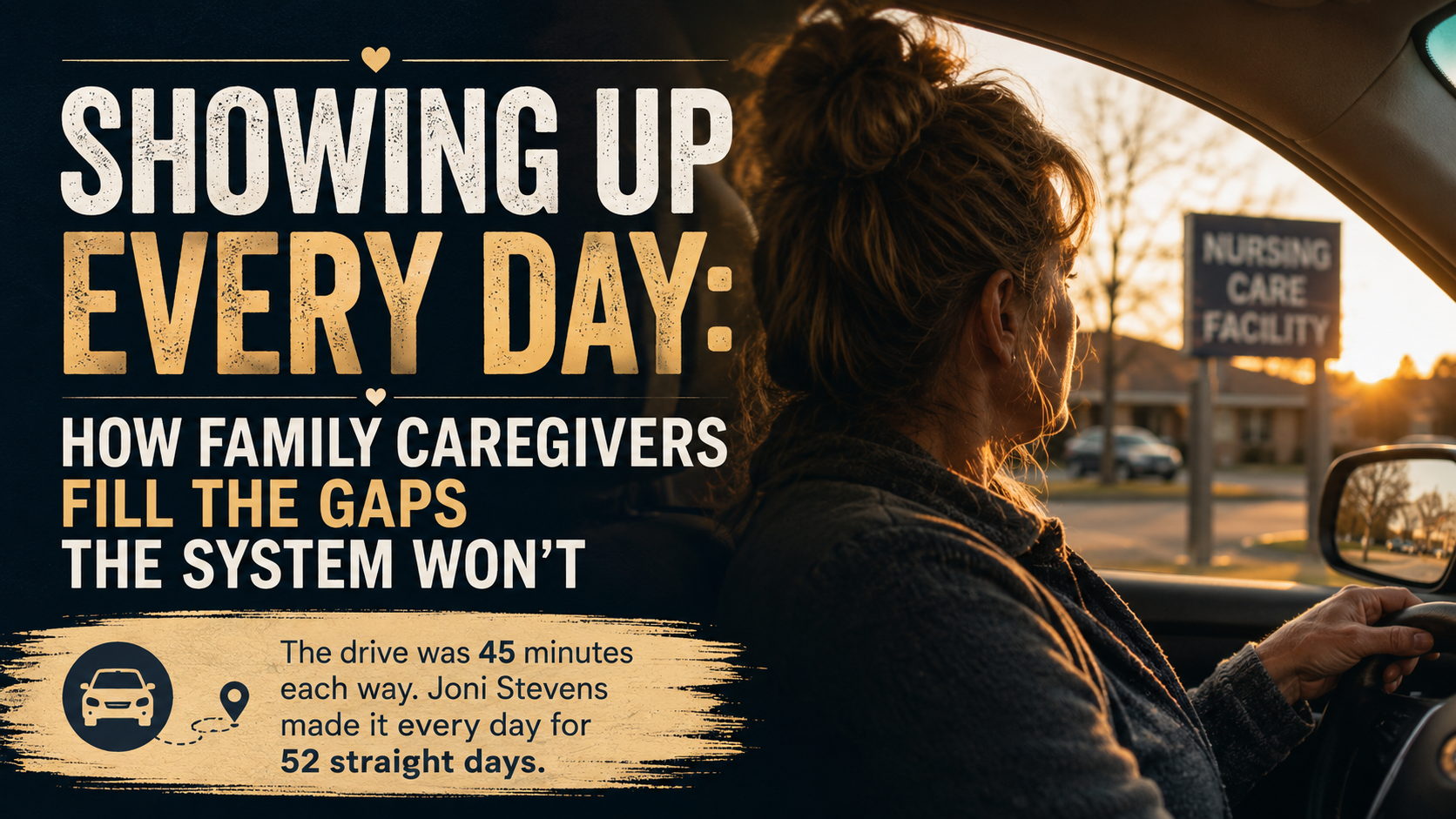
The drive was 45 minutes each way. Joni Stevens made it every day for 52 straight days.
That is not devotion as a concept. That is devotion as a schedule, a full gas tank, and a decision made every single morning to show up again because she already knew what happened when she was not in the room.
A recent profile published by IW Features tells her story. Joni left a 30-year career as a dance teacher, moved across the country, and became her mother Judy’s full-time caregiver after watching the healthcare system fail her in real time.
Some people will read that story and call it sacrifice. Joni would probably call it love. There is a difference, and that distinction is what I want to examine here.
When the System Pushes You Out of Your Own Life
Nobody plans to become a full-time caregiver. You do not grow up thinking you will one day learn wound care, tube feeding, and respiratory management so you can bring your bedridden mother home from a nursing facility because the alternative was watching her disappear inside it.
But that is exactly what Joni did. After Judy suffered a major stroke in 2024 and spent 52 days in a nursing home, Joni drove that route every single day. She saw what happened when she was not in the room. So she demanded the staff teach her every skill they were performing, and then she took her mother home.
The healthcare system calls that a discharge. Joni’s family experienced it as the only safe option left.
If you are a family caregiver reading this, you already know the version of this story that lives in your own house. You know what it feels like to walk into a facility and sense immediately that something is off. You know the exhaustion of becoming the person responsible for noticing everything because you are terrified of what happens if you stop.
That is not your failure. That is what happens when a system prioritizes volume, staffing minimums, and operational survival over individualized care.
Related on Silent Voices
Nursing Home Warning Signs Families Notice First When Nursing Home Concerns Get Dismissed by Staff When Facilities Label Your Family “Difficult”What the Healthcare System Does Not Tell Family Caregivers
Nursing homes are not designed to provide the kind of individualized, attentive care that most families imagine when they sign the admission paperwork. They are designed to manage large numbers of medically complex residents with the smallest staffing ratio they are legally permitted to maintain. That is not an accusation. That is the business model.
What this means in practice is that the elders who receive the most attentive care are almost always the ones with the most present, vocal, visible families. The ones who have someone showing up every day asking questions, reviewing care plans, and making noise when something is wrong.
Joni Stevens showed up every day for 52 days straight. Most families cannot do that. Most families have jobs, children, their own health issues, and a geographic distance that makes daily visits impossible. Facilities operate knowing most families cannot maintain that level of daily oversight.
And when a family member like Joni does show up every single day and still decides to take their loved one home because the care is not good enough, that decision gets framed as a personal choice. A lifestyle adjustment. A beautiful act of devotion.
It is also an indictment. Every family caregiver who removes a loved one from a facility after witnessing poor care is documenting a failure the system rarely has to answer for.
Related on Silent Voices
Preventable Death Is Not an Accident Nursing Home Bankruptcy and What It Means for Resident Safety The Language Nursing Homes Use and What It Actually MeansWhat Joni’s Mother Asked For
Judy’s wish was simple. She did not want to die in a hospital. She did not want to be left alone in a facility where no one knew her name. Joni kept that promise, even when other family members questioned her decisions about the house and the care plan. Even when the push came to put Judy in a nursing home permanently.
Joni’s power of attorney gave her the legal authority to make those decisions, but it did not make them any easier. The conflict over the house, the disagreements from relatives, the constant pressure to “just let the professionals handle it.” None of that prepared her for the reality of feeding, lifting, bathing, and advocating for her mother around the clock.
This is not a celebration of Joni’s devotion as an exception. Her story exposes what millions of families face when they have no choice but to become the safety net the system should provide.
“Every family caregiver who removes a loved one from a facility after witnessing poor care is documenting a failure the system rarely has to answer for.”
To the Caregiver Who Is Reading This at 2am
You did not fail your loved one by needing help. You did not fail them by placing them in a facility while you figured out what came next. You did not fail them if you are still trying to figure it out right now.
What you are doing, whether you are managing medications from three states away or lying awake running through the list of things you need to check on tomorrow, is not sacrifice in the way people mean when they say the word softly and shake their heads. It is love in its most operational form. It is love that shows up and does the next thing and does not stop.
The system was supposed to be part of this with you. It was supposed to be a partner in keeping your person safe and cared for and seen. The fact that so many of you are doing this largely alone is not a reflection of your capacity. It is a reflection of how badly the system has failed at the one job it exists to do.
Joni Stevens is one story with a name and a profile from IW Features. There are millions of versions of this story with no byline at all. You might be living one of them right now.
Silent Voices Resources for Family Caregivers
Signs of Nursing Home Abuse and Neglect How to Contact the Nursing Home Ombudsman Complaint Resources: Where to Report a Nursing Home How to Read CMS Nursing Home Ratings Law Firm Directory Full Silent Voices Resource LibraryWhat Comes Next
Every family forced into this position deserves answers from the systems that left them there. Those answers should include better home-care options, paid family leave, caregiver support programs, and nursing home accountability that goes beyond minimum staffing requirements.
Until then, families will continue filling the gaps the healthcare system keeps insisting are acceptable.
Silent Voices sees you.
Joni Stevens did not set out to become a symbol. Her story matters because it exposes how much of elder care still depends on family members stepping in where systems fall short.
Source: “I’m Here With You”: How One Daughter Is Changing What Elder Care Looks Like, IW Features. This profile anchors the analysis of family caregiving and systemic elder-care failure in this piece. All interpretation and argument is original to Silent Voices.
Nathalie Frias
CEHRS · CMAA
Certified electronic health records specialist and founder of Silent Voices Elder Advocacy, a platform for elder care accountability and fiction.

Silent Voices Elder Advocacy · Subscriber Edition
Did this story matter to you?
New investigations, case files, and fiction land in subscribers’ inboxes first. No noise. Just the work, when it is ready.
Subscribe · Stay InformedDiscover more from Silent Voices Elder Advocacy
Subscribe to get the latest posts sent to your email.
Leave a Reply