
Silent Voices Elder Advocacy · Investigative Analysis
Because silence is not the same as safety.
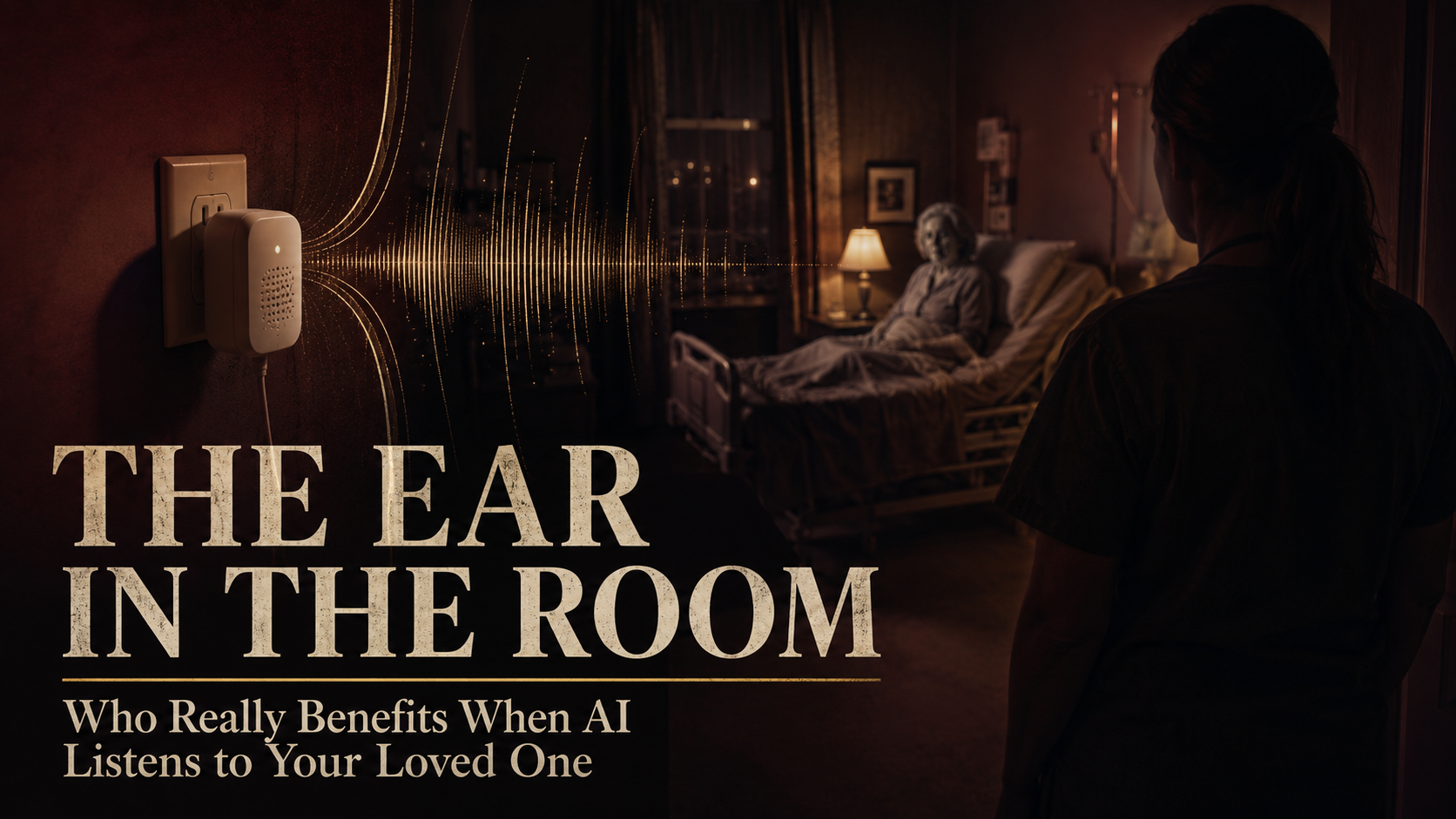
Sensi.AI describes itself as a Care Intelligence platform. Its marketing materials promise families peace of mind, agencies operational efficiency, and older adults a safer path to aging in place. The pitch is straightforward: a small device, plugged into a wall outlet, listens continuously to the home environment and alerts care teams when something changes.
No cameras. No wearables. No buttons to press.
Sensi.AI is not alone in this market. A growing number of healthcare and ambient intelligence companies, including platforms focused on acoustic monitoring, predictive behavioral analytics, fall detection, and remote caregiving oversight, are entering elder care as providers search for technological solutions to staffing shortages and rising clinical demands.
While this article focuses primarily on Sensi.AI because of its visibility within home care networks and publicly available operational material, many of the ethical and regulatory questions discussed here apply broadly across the ambient monitoring industry.
The Pitch
The company reports that its technology is used by a majority of the largest home care networks in North America. One agency owner credits the platform with reducing client hospitalizations by 80 percent. Another reports 88 percent growth in client base and 85 percent growth in billable hours following integration.
Many operational claims surrounding ambient monitoring platforms have not yet been independently validated through large-scale peer-reviewed clinical research.
That distinction matters.
The concerns examined in this article emerge not necessarily from technological failure, but from questions about how these systems are deployed, who authorizes their use, and what happens to the data they generate. The broader ethical and legal concerns examined here draw from existing privacy law, elder care regulation, and documented gaps in consent practices.
Audio-based monitoring systems are frequently presented as a privacy-conscious alternative to video surveillance. The absence of a camera, however, does not eliminate the ethical reality of continuous observation.
That is where the harder questions begin.
Related Reading · Silent Voices Nursing Home Warning Signs Families Notice First Read the investigation ›How It Actually Works
A caregiver helps an elderly woman to the bathroom at 2:13 a.m. The woman sounds confused. Her speech is slower than usual. A device plugged into the wall registers the interaction as a cognitive anomaly.
No one pressed a button. No one called for help. The system was already listening.
Sensi.AI operates through small hardware units the company calls care pods. Each pod plugs into a standard wall outlet and connects to the home or facility’s Wi-Fi network. The system does not stream continuous raw audio to the cloud. Instead, it processes sound locally first, filtering out background noise before transmitting structured event data for further analysis.
Upon installation, the system runs a mandatory two-week baseline calibration period. During this phase, it maps the acoustic environment of the space, recording typical sounds, appliance rhythms, and daily behavioral patterns. That baseline becomes the reference point for everything that follows. Any significant deviation triggers the classification system.
The analytical engine operates through three layers. The first filters environmental noise and distinguishes human sound from electronic sources such as televisions. It also registers mechanical changes, including the sudden cessation of medical equipment. The second layer processes speech using machine learning models trained on care-specific audio interactions. This training allows the system to parse slurred speech, cognitive hesitation, and tremors common in patients with neurological conditions. The third layer evaluates emotional tone, assessing pitch, volume, and cadence to differentiate distress from ordinary conversation.
Events the system calculates with above 90 percent certainty route directly to care teams or family members. Lower-confidence events route to human review. The extent and structure of that review process varies by deployment environment.
The system operates continuously, recalibrating behavior against the baseline environment in real time.
Related Reading · Silent Voices The Language Nursing Homes Use and What It Actually Means Read the investigation ›Who Consented
For many families, the decision to accept ambient monitoring does not happen under comfortable conditions. It happens during staffing shortages, hospital discharges, memory decline, and exhaustion. When a loved one has already fallen twice, when call lights go unanswered, when a family member cannot be present around the clock, the promise of a system that never sleeps carries understandable appeal.
That context matters. It also complicates consent.
True informed consent requires that an individual understand what data is being collected, how it is stored, who has access to it, and how long it is retained. For older adults with advanced dementia or acute delirium, that standard is frequently impossible to meet. When a resident lacks cognitive capacity to consent, legal authority transfers to a court-appointed guardian or a designated attorney-in-fact.
In practice, consent documentation is often obtained during discharge planning, a period when families are under significant stress and processing large amounts of unfamiliar information. Whether a family member in that moment fully understands the scope of continuous acoustic monitoring, its data retention policies, disclosure obligations, and dual-use function remains difficult to assess.
The consent burden does not stop at the resident.
In shared facility rooms, roommates present an additional consent requirement. A device installed for one resident captures ambient sound from the entire room. The roommate’s conversations, behaviors, and daily patterns become part of the acoustic data environment without necessarily providing direct clinical benefit to them and without a care relationship that might justify the intrusion.
Caregivers face a parallel issue. Many sign broad employment agreements that include monitoring acknowledgments. Whether those agreements constitute meaningful informed consent to continuous acoustic surveillance remains a question labor attorneys are beginning to examine more closely.
The rapid deployment of ambient monitoring technology raises questions about whether consent practices are keeping pace with the complexity of the systems being introduced.
Related Reading · Silent Voices When Nursing Homes Dismiss Family Concerns Read the investigation › Related Reading · Silent Voices When Nursing Homes Label Families as Difficult Read the investigation ›The Second Camera
The same device monitoring the resident monitors the worker.
Sensi.AI markets its platform to agencies in part as a caregiver oversight tool. The system tracks caregiver interactions, flags tonal anomalies during care, and feeds performance data into agency operational dashboards. That function is built into the product. It is not incidental.
The device does not distinguish between patient monitoring and employee monitoring. It captures both simultaneously.
This creates a workplace dynamic that goes beyond standard supervision. The system’s analytical layer evaluates tonal and behavioral patterns during care interactions. A caregiver whose voice registers elevated stress during a physically demanding transfer or behavioral episode generates a structured event log. That log becomes part of an audit trail agencies access through a centralized dashboard.
Agencies deploying these systems may argue that structured oversight improves accountability, documents difficult interactions, and protects caregivers from false allegations. That argument has merit in specific circumstances.
What it does not resolve is the broader question of scale. Emotional labor, the work of managing tone, affect, and composure under physically and cognitively demanding conditions, becomes data. Whether algorithmic systems calibrated on idealized behavioral models accurately reflect the realities of direct care work is not a question the technology answers.
The concern is not that caregivers will behave worse. The concern is that performance under surveillance is not the same as care under trust, and that the difference matters for residents.
Related Reading · Silent Voices Preventable Death Is Not an Accident Read the investigation ›When Something Goes Wrong, Who Pays
Under Sensi.AI’s Data Processing Agreement, the company acts strictly as the Data Processor. The deploying home care agency or long-term care facility acts as the Data Controller.
That designation carries significant legal weight.
As the Data Controller, the agency assumes full responsibility for obtaining all required consents. That includes consent from the resident, consent from any roommates sharing the space, and acknowledgment from employees subject to monitoring. The operational and legal responsibilities remain largely with the deploying agency.
The legal complexity deepens when state wiretapping law enters the picture. Under federal baseline standards, one-party consent governs audio recording. However, approximately eleven to twelve states enforce all-party consent requirements, meaning every participant in a recorded conversation must explicitly consent. In California, recording without prior informed consent constitutes a criminal offense, with statutory damages reaching up to $5,000 per violation. Florida enforces similar standards.
These states represent major population centers. Agencies deploying ambient monitoring systems across multiple locations face a compliance matrix that varies by state, by facility type, and by the cognitive status of each individual resident.
How these statutes apply to AI-processed acoustic event capture, rather than traditional continuous recordings, remains an evolving legal question.
The liability structure becomes more complicated once acoustic event data intersects with consent documentation, roommate notification requirements, and employee monitoring policies. Ongoing litigation testing whether AI service providers share joint liability with deploying agencies in certain monitoring contexts has not yet produced settled law. The regulatory gap is real and currently unresolved.
Related Reading · Silent Voices Nursing Home Bankruptcy and What It Means for Resident Safety Read the investigation › Silent Voices Resources How to File a Complaint Against a Nursing Home or Home Care Agency Access the resource ›The Questions Families Should Be Asking
Families considering or already living with ambient monitoring in a loved one’s care environment have the right to direct, plain answers to the following questions. If an agency cannot answer them clearly, that is information worth having.
Six questions. Six rights. Ask them directly.
Is audio stored, and for how long?
Who reviews alerts generated by the system?
Can my family member refuse monitoring, and what happens to their care plan if they do?
Are caregivers recorded by the same device?
What happens to the data after my family member dies?
Has this system been independently clinically validated outside of company-supported pilots?
These are also the questions state licensing boards and long-term care ombudsman programs have not yet required agencies to answer formally.
Silent Voices · Know Your Rights How to Contact a Nursing Home Ombudsman and What to Expect Read the guide › Silent Voices Resources How to Read CMS Nursing Home Ratings and What the Numbers Mean Access the resource › Silent Voices Resources Elder Care Law Firm Directory Find legal help ›Artificial intelligence is already becoming part of modern healthcare. Systems like Sensi.AI can identify patterns, detect behavioral changes, and process information at a scale no human staff member could manage alone.
But elder care was never meant to function on detection alone.
AI systems can monitor a room continuously. Responsibility for what happens inside it still belongs to the people entrusted with care.
Silent Voices Resources Signs of Nursing Home Abuse and Neglect: A Family Reference Guide Access the resource › Silent Voices Full Resource Library for Families and Advocates Browse all resources ›About the Author
Nathalie Frias
CEHRS · CMAA
Nathalie Frias, certified electronic health records specialist and founder of Silent Voices Elder Advocacy, a platform for elder care accountability and fiction.
Her writing translates clinical documentation into evidence families and advocates use to expose neglect, financial exploitation, and regulatory failures in long-term care. Read more

Silent Voices Elder Advocacy · Subscriber Edition
Did this story matter to you?
New investigations, case files, and fiction land in subscribers’ inboxes first. No noise. Just the work, when it is ready.
Subscribe · Stay Informed
Leave a Reply