
Nursing Home Quality · June 7, 2026
You found a five-star facility. You toured it on a Tuesday afternoon. The lobby smelled like something warm was baking. The administrator shook your hand and handed you a brochure with the CMS badge printed right on the cover. You felt relief.
That relief is exactly what the rating system is designed to produce. And that is the problem.
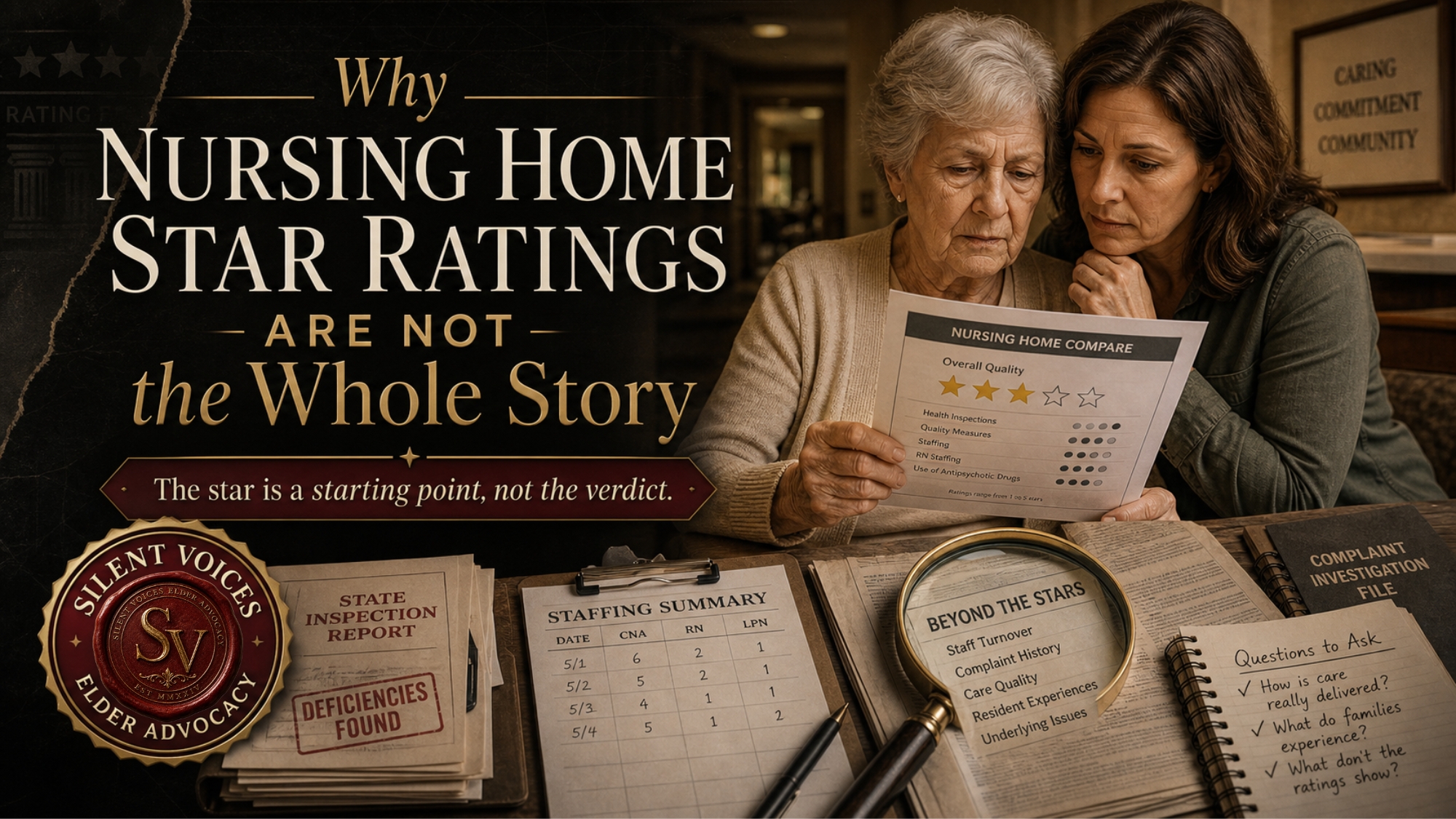
The CMS Five-Star Quality Rating System was introduced in 2008 because Congress noted it was easier for an American consumer to shop for a washing machine than to evaluate a nursing home. That framing tells you everything about what the system was built to do: reduce a complex clinical environment to something digestible enough that families stop asking harder questions. Federal audits, investigative reporting, and peer-reviewed research have spent the years since 2008 documenting exactly how well that worked, and how badly it failed the people it was supposed to protect.
This is not an argument against using the star rating. It is an argument for knowing what it is actually measuring, and for understanding the machinery behind it before you hand someone you love over to it. We cover the full breakdown of how to read CMS ratings on our CMS ratings guide, and you will find a fuller set of evaluation tools on our Silent Voices resources page.
Three numbers inside one star
The overall star rating is a composite of three separate domains. Health Inspections, which is the only domain based on actual third-party evaluations by state surveyors. Staffing, which historically relied on data the facility reported about itself. And Quality Measures, which is calculated almost entirely from clinical assessments the facility fills out about its own residents.
The Staffing and Quality Measures ratings can each add or subtract a star from the baseline Health Inspection score. Which means a facility can fall short on its independent inspections and still achieve a high overall rating by posting strong numbers in the two domains it controls. CMS built a mathematical cap into the formula to limit that, capping facilities with a one-star inspection at two stars overall regardless of their other scores. That cap is an admission. If the self-reported data were reliable, the cap would be unnecessary.
How the composite score is built
- Step 1 — Health Inspection rating becomes the baseline. Third-party. Unannounced surveys.
- Step 2 — Five-star Staffing adds one star. One-star Staffing subtracts one.
- Step 3 — Five-star Quality Measures adds another star. One-star subtracts another.
- Cap rule — One-star inspection facilities cannot exceed two stars overall, no matter what their other scores show
- Special Focus Facilities — Facilities with persistent severe violations are capped at three stars maximum
A grading curve no one tells families about
Here is something the brochure does not mention. Health Inspection ratings are not graded against a national standard of safe care. They are graded on a curve within each state. CMS locks the distribution so that exactly 10% of facilities in every state receive five stars in the Health Inspection domain, and exactly 20% receive one star, regardless of the actual quality of care in that state.
A facility that would receive two stars in a state with aggressive enforcement could receive four or five stars in a state with lax oversight, simply by outperforming its local competitors. The rating tells you how a facility compares to its neighbors. It says nothing about whether those neighbors are safe. In a state where most facilities are inadequate, the five-star facilities are just the least inadequate ones in the room.
The staffing numbers were invented
For years, nursing homes self-reported their staffing levels during a two-week window immediately before their scheduled annual inspections. Facilities staffed up for the window, posted the numbers, and reverted to skeleton crews once the surveyors left. This was not speculation. When the government finally transitioned to auditable payroll data, the gap became visible.
An analysis by the Center for Public Integrity of over 10,000 nursing homes found that more than 80% had reported higher registered nurse coverage on their public profiles than what their audited Medicare financial records showed. In more than a quarter of those facilities, the advertised RN staffing was at least double the daily reality. When CMS implemented the Payroll-Based Journal system, the data showed that in the last quarter of 2017, 25% of facilities reported having zero registered nurses on duty for at least one day, in direct violation of federal licensing requirements.
Analysis of nearly 500 million nurse shifts found median annual nursing staff turnover of 94%, with RN turnover reaching 140.7% and CNA turnover at 129.1%, according to research published in Health Affairs. High turnover disrupts continuity of care and makes subtle clinical changes easier to miss. When a facility replaces its entire registered nurse staff more than once a year, the person caring for your loved one today may have no institutional knowledge of who they were six months ago.
The diagnosis that changed the metric
The Quality Measures domain tracks 15 clinical outcomes, including antipsychotic medication use. CMS flags high antipsychotic use as a negative quality indicator because these drugs are frequently used as chemical restraints on dementia patients who are difficult to manage in understaffed environments. There is a carveout in the methodology: residents with a documented schizophrenia diagnosis are excluded from that metric entirely.
A March 2026 report by the HHS Office of Inspector General found that schizophrenia diagnoses were being added to residents’ records at rates inconsistent with clinical prevalence, removing those residents from the antipsychotic quality measure and allowing facilities to maintain high scores on that metric regardless of actual medication practices. A September 2025 OIG report found separately that nursing homes failed to report 43% of falls resulting in major injuries and hospitalizations among Medicare residents. Unreported falls do not count against the score.
The Quality Measures domain is built on data the facility generates about itself, with no routine independent verification before CMS uses it to calculate the rating. An empirical study published in INQUIRY estimated that between 6% and 8.5% of all nursing homes actively inflate their self-reported measures. The facilities most likely to do it are large, for-profit, chain-affiliated facilities with the most financial incentive to boost their public score. Because a five-star Quality Measures rating automatically adds a full star to the overall composite, the inflation lands directly in what families see on Care Compare.
The citations that disappear during appeals
When state surveyors cite a facility for a severe violation, that facility can appeal the citation. Certain appealed deficiencies may not be reflected in public ratings until the appeal process concludes. While an appeal is active, those citations are excluded from the star rating calculation. The appeals process can run for over a year. During that time, residents and their families have no access to those proceedings. Negotiations take place between the facility’s legal team and government attorneys, and the government frequently agrees to downgrade or withdraw citations to avoid prolonged litigation.
A New York Times investigation identified approximately 2,700 dangerous incidents, documented by state inspectors, that were completely hidden from the public due to active or negotiated appeals. According to CMS data, only 50 Administrative Law Judge decisions regarding nursing home penalties were issued in 2020, a fraction of the thousands of serious deficiency citations filed during that same period.
The rating you see on Care Compare is not the rating the facility earned. It is the rating that survived the paperwork.
What to look at instead
Use the star as a door. Then walk through it and do this.
Look at the Health Inspection sub-score separately
A five-star overall rating built on a two-star Health Inspection means the facility compensated for failing its independent evaluation with better self-reported numbers. That is the opposite of reassuring. The Health Inspection sub-score is the only part of the rating the facility did not help produce.
Read the CMS Form 2567 for the facility
Form 2567 is the actual inspection report. It contains the raw narratives written by state surveyors, including scope, severity, and the specific details of every deficiency cited. This is what the composite number compresses into a single digit. Access it through CMS Care Compare or request it directly from the facility. Read what actually happened, not the score it produced.
Check RN turnover and weekend staffing specifically
Care Compare now shows staff turnover rates separately. RN turnover above 100% annually means the facility replaced its entire registered nurse staff at least once that year. Weekend staffing data tells you what the facility looks like when administration is not in the building. Those two numbers reveal whether the staffing star means anything in practice.
Visit unannounced on a weekend evening
Facilities staff for scheduled tours and inspections. Show up on a Saturday night. Note how long it takes a call light to be answered. Count the staff visible on the floor. Look at the condition of common areas and whether residents appear attended to. Thirty minutes on a weekend evening tells you more about that facility than any composite score ever will.
Call the Long-Term Care Ombudsman before placement
Ombudsmen visit facilities regularly and handle real-time grievances. They know what is happening inside a building right now, not six months ago when the last survey was filed. The CMS database lags. The ombudsman does not. Find yours through the Eldercare Locator or by calling 1-800-677-1116.
The star rating is a starting point. It was never designed to be the last word. For a full walkthrough of how to read each component of the CMS rating, visit our CMS ratings guide or go directly to CMS Care Compare to pull a facility’s inspection history. The families who walk in knowing what the star does and does not measure are the ones who ask better questions, catch what the brochure hides, and are ready to act when something changes.
If you are in Arkansas
When the star rating was not enough
The Center for Public Integrity identified Arkansas and Louisiana as the only two states where average self-reported RN care was more than twice the audited reality. Two cases show what that gap looks like when it reaches a resident.
Murfreesboro Rehab and Nursing — license revoked May 2026
The Arkansas Office of Long Term Care revoked the operating license of Murfreesboro Rehab and Nursing in May 2026 after an Immediate Jeopardy citation for financial exploitation and clinical neglect. A United States Treasury check for $56,481 arrived for a resident. Facility staff intercepted the mail, endorsed the check without consent, and deposited it into the facility’s operating account, which held a balance of $16.83 at the time. The resident asked repeatedly about the funds and suffered health consequences as a direct result of the facility’s inaction. The state revoked both the facility license and the administrator license and appointed emergency management to relocate 35 residents.
Golden Living — $72 million class action, 2017
Twelve Golden Living facilities in Arkansas settled a class action lawsuit for $72 million. Depositions from seven Directors of Nursing revealed that local clinical leaders had no authority over their own staffing budgets. Corporate leadership overrode repeated warnings that facilities were operating below safe thresholds. The failures generated over 3,000 resident grievances. The facilities were reporting staffing levels to the state that did not reflect what was happening at the bedside.
To check any Arkansas facility’s current inspection history, use CMS Care Compare or visit our CMS ratings guide for a step-by-step walkthrough. For complaints about a licensed facility, contact the Arkansas Office of Long Term Care at 1-800-582-4887.
Previously in this series

Silent Voices Elder Advocacy · Subscriber Edition
Did this story matter to you?
New investigations, case files, and fiction land in subscribers’ inboxes first. No noise. Just the work, when it is ready.
Subscribe · Stay Informed
Leave a Reply