
Advocacy · June 11, 2026
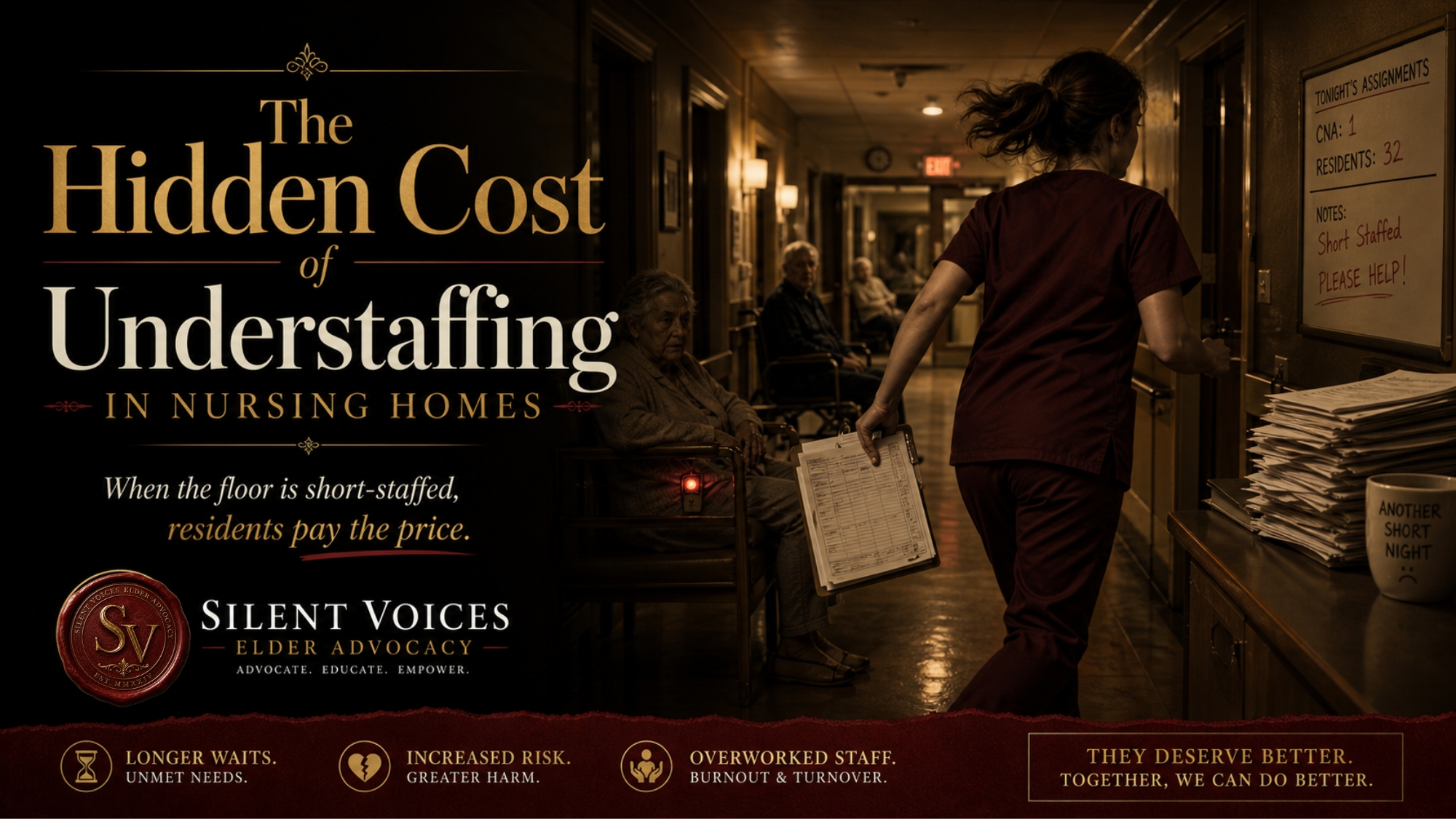
I have been a CNA. Not in theory. On the floor, on the night shift, with a hallway full of residents who needed to be repositioned, medicated, toileted, and talked to, and a schedule that made all of it mathematically impossible before the sun came up. I know what it feels like to walk past a call light because you are already three rooms behind and someone else is coding down the hall. I know the specific kind of guilt that comes from doing your best in a system designed to make your best not enough.
I also know what that looks like inside a medical record. After years of pulling nursing home charts at a malpractice law firm and now working in health information, I can read the gap between what was charted and what was possible given the staffing levels documented in the same file. Those two numbers rarely match. And the distance between them is where residents get hurt.
This article is about understaffing, what it actually costs, who profits from it, and what is happening right now that should concern every family with a loved one in a nursing home. You will find additional context on our Silent Voices resources page.
The numbers behind the shortage
As of July 2025, there are 14,742 nursing facilities certified by CMS housing approximately 1.24 million residents. The national average staffing level is 3.85 total nursing hours per resident day, a 7% decline from pre-pandemic levels driven largely by a 19% reduction in Registered Nurse hours. A 2001 federal study established 4.1 hours per resident day as the minimum threshold to prevent clinical harm. As of current tracking, only 26.8% of nursing homes meet that two-decade-old standard.
A review of available data maps what that shortage looks like across the workforce and what it produces clinically.
Data · Annual turnover rates by staff role
CNA turnover approaches 100% annually in chronically understaffed facilities
Data · Adverse events per 100 residents: staffed vs understaffed facilities
Incidents per 100 residents annually
What understaffing actually costs residents
Pressure ulcers are universally recognized as a primary indicator of nursing home neglect. Up to 28% of nursing home residents develop bedsores during their stay. Preventing them requires turning immobile residents every two hours, managing incontinence promptly, and using pressure-relieving equipment. Turning an adult resident safely almost always requires two aides. When facilities are short-staffed, that repositioning gets skipped. Stage 3 and Stage 4 wounds follow. Sepsis follows that. The Agency for Healthcare Research and Quality estimates that pressure ulcer complications claim approximately 60,000 lives annually.
Falls carry a similar calculus. Approximately 23.5% to 25% of patients discharged from hospitals to nursing facilities are readmitted within 30 days, and an estimated 67% to 78% of those readmissions are considered preventable. When there is no RN present to catch the early signs of a urinary tract infection, a routine infection becomes urosepsis. A readmission becomes a Medicare penalty. A penalty becomes a revenue cut. And none of that reaches the resident who was left untreated long enough for it to get that far.
The psychological cost is less visible but just as real. Studies show that 61% of nursing home residents report moderate loneliness and 35% experience severe loneliness. When CNAs are stretched across impossible patient loads, every interaction becomes transactional. Medication administered. Food tray delivered. Brief changed. There is no time left for the kind of presence that keeps a person from disappearing into themselves. More than half of the long-stay nursing home population carries a diagnosis of clinical depression. Facilities without adequate staff to address that frequently turn to antipsychotic medications to manage the behavior that results from unmet need. That is not treatment. That is containment.
What families can watch for
How to spot understaffing during a visit
- Call lights ringing for extended periods with no response
- Residents waiting for toileting assistance beyond a reasonable time
- One aide visibly covering multiple hallways alone
- Meals arriving late, cold, or unassisted for residents who need help eating
- Staff rushing between rooms without stopping to acknowledge residents
- Frequent unfamiliar faces, agency staff who do not know the residents by name
- Different staff present on every visit with no continuity from one week to the next
The vicious cycle no facility escapes
Understaffing does not stay in one lane. It moves through a facility in a predictable sequence that every CNA who has worked a short floor can describe from memory.
Initial shortage. Not enough staff to cover the floor safely. Remaining staff absorb impossible workloads.
Burnout accelerates. A 2022 CDC study found 46% of health workers reported burnout often or very often, up from 32% in 2018. Among care aides, emotional exhaustion averaged 43%.
Turnover follows. CNA turnover declined slightly to 42.34% in 2025 but remains catastrophic. RN turnover rose to 17.6%, reversing previous declines. Replacing a single RN costs between $56,300 and $60,090.
Agency labor fills the gap at enormous premium. Travel nurses average $91 per hour, scaling to $160 during acute shortages. A longitudinal analysis of 35,200 facilities found that high agency utilization increased permanent RN turnover by 7.7%, meaning the solution actively accelerates the problem it is solving.
Budget collapses. Agency costs drain what could have funded permanent wage increases. Permanent staff see temporary workers earning significantly more for the same work. More permanent staff leave. The cycle repeats.
When understaffing is a business strategy
The most disturbing part of this story is not that some facilities cannot afford adequate staffing. It is that some deliberately choose not to staff adequately because the money that would pay for nurses is being routed somewhere else. Three cases investigated by the New York Attorney General make this visible in specific, documented detail.
Cold Spring Hills Center for Nursing and Rehabilitation
In late 2022 the New York AG sued the owners of this 588-bed Nassau County facility for fraudulently diverting over $22.6 million in Medicaid and Medicare funds through a network of 13 shell companies. The diversions included $15.3 million in fabricated rent paid to a real estate entity owned by the same operators, $5.2 million funneled into sham consulting firms, and millions more extracted through self-dealing insurance and supply companies. To offset the losses, operators implemented a $1.6 million budget cut targeting labor.
A diabetic resident was given a wheelchair without footrests. He was forced to drag his foot on the floor. He developed severe sores, a bone infection, an amputation, and died. Another resident, admitted to recover from a car crash, developed a Stage 4 bone infection and severe malnutrition. He told his wife “They tried to kill me at Cold Spring Hills” before he died. During the pandemic, the facility fraudulently underreported COVID-19 deaths by 52%.
Van Duyn Center for Rehabilitation and Nursing — $12 million settlement, 2025
Owners of the Van Duyn facility in Syracuse extracted $100.1 million in Medicaid reimbursement payments between 2014 and 2020 through inflated rent and fraudulent salary payments. The facility operated at an average of 3.24 hours per resident day against a clinical need of 4.84, roughly 33% understaffed. On weekends, staffing collapsed to 2.74 hours per resident day.
A resident fell and was strangled to death when her nightgown caught on a door handle because no staff were present to assist her to the bathroom. Another was found dead in rigor mortis due to total neglect and failure to provide medication. In a separate incident, staff improperly discharged two cognitively impaired patients and abandoned them outside a county welfare office with no identification. The case settled for $12 million in 2025 with mandatory independent health and financial monitors installed.
The Villages of Orleans
Owners of this facility formed a separate entity specifically to purchase the real estate, then charged the operating facility inflated rent, routing public Medicaid dollars into private pockets. The financial extraction drove chronic understaffing that resulted in untreated Stage 2 bedsores, rampant falls, and severe resident malnutrition. The pattern was identical to the other cases: money meant for nurses left the building through a legal structure designed to make it invisible.
CMS data indicates that 95% of nursing home abuse and neglect incidents link directly to inadequate staffing levels. The average settlement for nursing home neglect ranges from $400,000 to $600,000, with wrongful death cases regularly exceeding $1 million to $2 million. The legal exposure of deliberate understaffing is enormous. It just rarely comes due fast enough to stop the harm already in motion.
The federal staffing mandate that did not survive
In May 2024, the Biden Administration finalized the first-ever federal minimum staffing standards for nursing homes: 3.48 total hours per resident day, including 0.55 RN hours and 2.45 CNA hours, plus a requirement for an RN to be physically on-site 24 hours a day, 7 days a week. The industry cited an estimated $6.8 billion annual implementation cost. In April 2025, a Texas federal judge overturned the mandate. By December 2025, the incoming administration rescinded it entirely.
There is now no federal minimum staffing floor for nursing homes in the United States. The 2001 standard of 4.1 hours per resident day was never mandated. The 2024 standard of 3.48 hours was overturned before it took effect. What remains is a system where facilities set their own staffing levels, self-report their own quality data, and appeal the citations they receive when the outcomes of those choices are documented by state surveyors.
What is happening right now
The 2025 Medicaid cuts and what they mean for residents
On July 4, 2025, a federal budget reconciliation law was enacted projecting $911 billion in federal Medicaid spending cuts over the next decade. The law caps State-Directed Payments to Medicare rates and prohibits states from creating new provider taxes to offset Medicaid shortfalls. Medicaid is the primary payer for 63% of nursing facility residents and long-term care accounts for over one-third of all state Medicaid budgets.
When federal Medicaid funding contracts, states cut reimbursement rates to facilities. When reimbursement rates fall, facilities cut the one expense they have always cut first: staffing. There is no federal minimum staffing mandate to prevent that. The self-reporting system that inflates quality measure scores is still in place. And 1.24 million people are living inside facilities navigating all of this right now.
Understaffing is not a staffing problem. It is a policy problem dressed as an economic one. And families pay the price in the only currency that cannot be recovered.
If you want to evaluate a facility’s staffing before placement, the CMS Care Compare tool shows RN turnover rates and weekend staffing data separately from the overall star rating. Our CMS ratings guide explains how to read what you find there. The next article in this series covers what families should know before trusting a facility with someone they love.
Previously in this series

Silent Voices Elder Advocacy · Subscriber Edition
Did this story matter to you?
New investigations, case files, and fiction land in subscribers’ inboxes first. No noise. Just the work, when it is ready.
Subscribe · Stay Informed
Leave a Reply