
Documentation · June 9, 2026
I work in health information. Before that, I spent years pulling medical records at a malpractice law firm, reviewing nursing home charts for cases that were already too late. I know what a care plan looks like when it is being followed and what it looks like when it is being invented after the fact.
That background is why this article exists. This is not general advice about keeping notes. This is a framework built from the inside of the records themselves, written for families who are standing in a facility room right now wondering what they are looking at and whether it matters.
It matters. You will find supporting tools on our Silent Voices resources page, and our Signs of Abuse and Neglect family guide is available as a free downloadable PDF you can print and take with you on visits.
Why documentation is the work
Neglect is defined by omission, not commission. There is no bruise. No single moment. It is the meal that never came, the repositioning that was charted but never done, the wound that was dressed on paper three days before anyone touched it. That is exactly why agencies dismiss complaints built on emotion and act on complaints built on records.
The burden of proof in a neglect case does not require absolute certainty. Under most state APS frameworks, a preponderance of the evidence standard applies, meaning it only needs to be more likely than not that neglect occurred. Your documentation is what tips that scale. Without it, investigators are choosing between your word and the facility’s chart. With it, they are choosing between two sets of records, and yours has timestamps, photographs, and names.
A review of available data on substantiated neglect cases shows which signs appear most frequently in complaints that actually moved forward. Before we get into the documentation framework, here is what the data shows.
Data · Warning signs in substantiated neglect cases
Frequency of indicators in substantiated neglect cases (%)
Data · Distribution of neglect types reported
Financial and emotional neglect are frequently under-documented relative to their actual prevalence
The 5 W’s: your documentation standard
Every entry in your documentation log needs to answer five questions. This is not a journalism exercise. This is the same standard used in clinical documentation, investigative reports, and legal proceedings. If your note cannot answer all five, it is incomplete.
WHO
Full name of the resident. Full name and title of any staff member present. Full name of any witnesses. Your name and your relationship to the resident.
WHAT
Exactly what you observed. Not what you felt about it. Not what you think it means. What you saw, heard, smelled, or measured. Objective and specific.
WHEN
Exact date and time of your observation. If it is a continuing condition, document the first time you noticed it and every subsequent observation.
WHERE
Specific location. Room number, wing, facility name and full address. Not “in her room.” Room 214, east wing, facility name, city, state.
WITNESSES
Anyone else present who saw the same thing. Collect names and contact information. Their corroboration transforms your single observation into a pattern that investigators cannot dismiss.
What to document on every visit
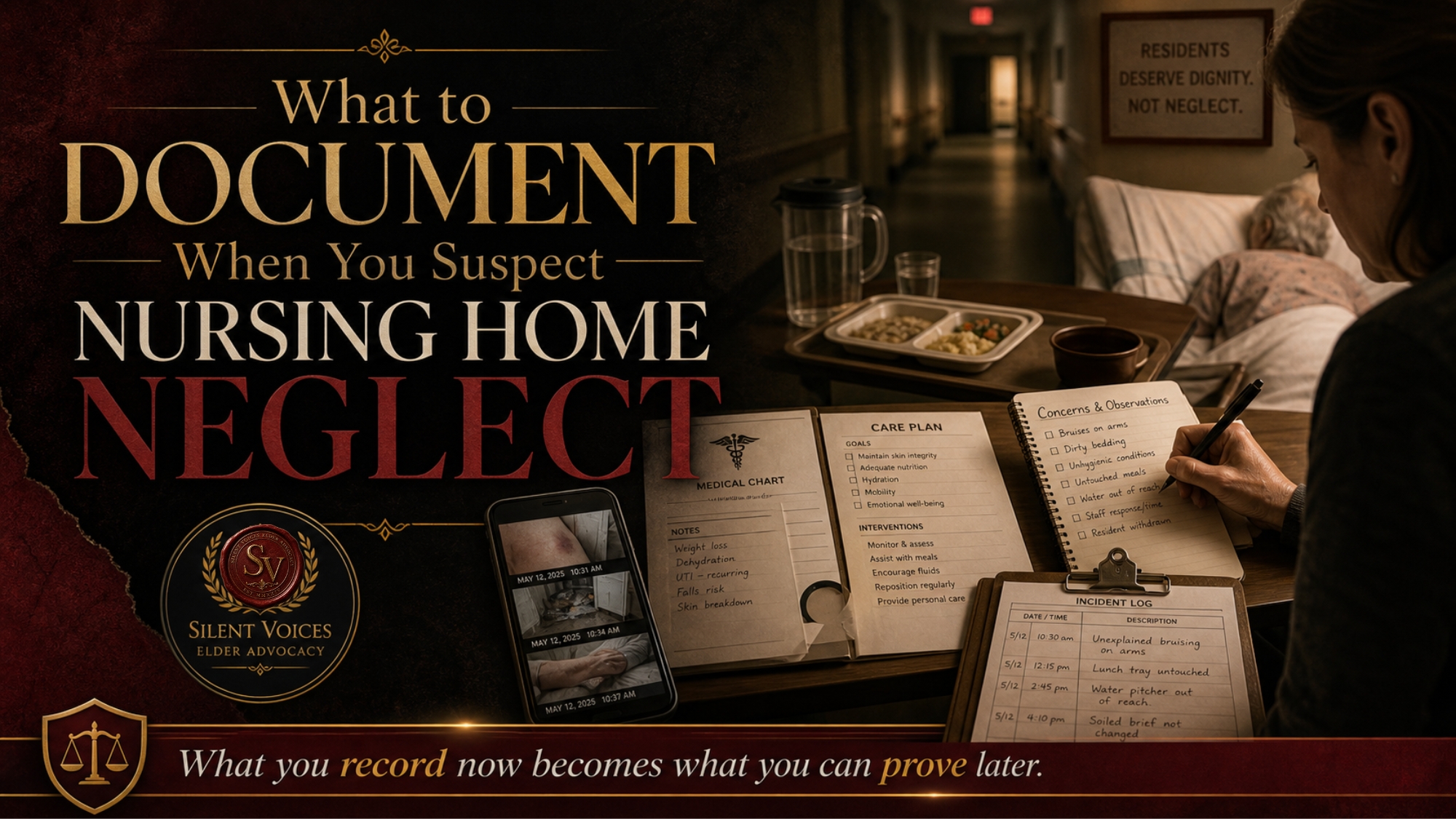
Documentation is most powerful when it is consistent. A single observation is a data point. Ten observations across ten visits are a pattern. Use this checklist on every visit so your log builds into something an investigator can actually work with.
Every visit checklist
- Date and exact arrival time
- Resident’s appearance, clothing, and hygiene at the moment you arrive
- Mental status and alertness, noting any changes from the previous visit
- Whether food and water are within reach and whether the meal tray shows signs of being eaten
- Call light location and whether it is accessible to the resident
- Condition of the room, including odors, bedding, trash, and floor
- Any visible injuries, skin changes, or new wounds
- Staff interactions observed during your visit, including names if visible on badges
- Any statements made by the resident, recorded in their exact words
- Your exact departure time
What objective documentation actually looks like
The difference between a complaint that gets dismissed and one that triggers an investigation is almost always language. Emotional language gives facilities an easy rebuttal. Objective, measurable language does not.
Side by side
Subjective — gets dismissed
“The staff is ignoring my mother. She looks terrible and smells bad. They are not feeding her enough.”
Objective — gets investigated
“October 12, 2:00 PM. Room 214, Greenfield Care Center, Little Rock, AR. Resident wearing same clothing observed on October 11. Breakfast tray on bedside table, untouched, at 2:00 PM. Resident weight measured at 115 lbs using facility scale. Previous documented weight October 1: 122 lbs. Seven pound loss in 11 days. Call light was on. No staff responded during my 22-minute visit. CNA on duty: badge read ‘Maria S.’ No wound care documented in the visible section of the care binder on the door.”
The second entry has names, measurements, times, and a specific observation about the call light. An investigator reading that entry knows exactly what to look for when they pull the MAR, the weight log, and the nursing progress notes. They can cross-reference your record against the facility’s record. Discrepancies between the two are what build a case.
What to photograph and how
Photographs are timestamped, objective, and hard to dispute. Under Arkansas Code § 12-12-1712, investigators are explicitly authorized to photograph visible conditions of maltreatment. As a family member visiting, you can photograph what is visible in the room with the resident’s consent, while respecting facility policies and the privacy rights of other residents who may share the space.
Silent Voices resource
Our Signs of Abuse and Neglect family guide includes a printable checklist organized by category covering physical, behavioral, financial, and neglect indicators. Download the free PDF and bring it with you on your next visit so you have a structured reference while you document.
What to photograph
- Skin conditions, discoloration, or wounds, from multiple angles and distances
- Soiled clothing or bedding, with the resident’s consent
- The water pitcher and whether it is within reach
- Food trays noting what was eaten and what was not
- The call light position and whether it is accessible
- Environmental conditions: soiled floors, overflowing trash, stained bedding
- Missing equipment: empty eyeglass case, hearing aid charger with no device, walker stored out of reach
Every photograph should be taken on a device that embeds metadata including the date, time, and location. Do not edit or filter the images. Do not delete anything. The metadata embedded in an unedited photograph is a legal timestamp that a facility cannot retroactively alter in its chart.
The records to request and what to look for
If you hold Medical Power of Attorney, you have the right to request the complete medical record. Submit the request in writing to the Director of Nursing. Here is what to ask for specifically and what each document tells you.
Medication Administration Record
Shows every medication administered, by whom, and when. Look for identical administration times across dozens of residents, unsigned entries, and gaps in insulin, blood pressure, or anticoagulant administration. A missed blood thinner dose is a clinical emergency documented as a checkbox.
Minimum Data Set
The comprehensive clinical assessment completed by the facility’s own staff. It drives the care plan and the quality measures star rating. Compare the psychosocial section against behavioral changes you have observed. Compare the skin integrity section against any wounds you have photographed.
Wound Care Log
Documents every wound assessment and treatment. If you photographed a Stage 2 wound on October 12 and the wound log shows no documented assessment until October 15, the gap is the evidence. That three-day window is what you report.
Dietary Weight Log
Facilities are required to track resident weight regularly. A loss of 5% in 30 days or 10% in 180 days triggers mandatory clinical review. If the log shows missing entries or weight measurements that do not match what you documented yourself, that discrepancy belongs in your complaint.
Internal Incident Reports
Every fall, injury, or significant event is supposed to generate an internal incident report. If a fall you witnessed has no corresponding report, or if the report describes the incident differently than what you documented, that is a direct evidentiary conflict the facility cannot explain away.
Public records to pull before and during a complaint
Your personal documentation is stronger when it sits alongside the facility’s public record. These sources are free and accessible before you ever file a complaint. Treat them as supplemental context rather than proof of wrongdoing on their own. Their value is in showing pattern, not in making the case by themselves.
- CMS Care Compare — inspection history, Form 2567 deficiency narratives, staffing data, and turnover rates for every certified nursing home in the country
- Arkansas Court Opinions — civil and criminal case decisions involving the facility or its operators, searchable by name
- State licensing board records — check whether the facility’s license is in good standing and whether any disciplinary actions have been filed against specific staff members
- County property and financial records — if financial exploitation is suspected, public property records can reveal sudden changes in deed ownership or asset transfers. These records should be viewed as supplemental information and context, not as standalone evidence of wrongdoing
You are protected for reporting in good faith
This is the section most families never see and need the most. One of the most common reasons families delay reporting is fear. Fear that they are wrong. Fear that the facility will retaliate. Fear that they will be sued for making an accusation that cannot be proven.
Under Arkansas Code § 12-18-107 and corresponding adult abuse statutes, any person participating in good faith in the making of a report is immune from civil and criminal liability. The statute explicitly presumes good faith. That protection holds even if the subsequent investigation comes back unsubstantiated. Even if the agency concludes the neglect did not occur. Even if the facility disputes everything you said.
The only exception is if a court finds that you knowingly and maliciously made a false report. A concern you documented in real time, in your own handwriting, with photographs and dates, does not look like a malicious false report. It looks like exactly what it is: a family member who paid attention.
Most states carry equivalent protections. If you are outside Arkansas, search your state’s APS reporting statute for the immunity provision. It is there. Report anyway.
Keep everything
Do not delete photographs after you file. Do not throw away handwritten notes once an investigation opens. Do not assume the investigation is over because the agency went quiet. Keep copies of every complaint you submit, every reference number you receive, and the name of every person you spoke to.
Your documentation is a chain of custody. Break the chain and the case weakens. Maintain it and you have something even the facility’s attorney has to reckon with.
The system protects itself. Documentation is how you protect the person inside it.
Free resource · Silent Voices Elder Advocacy
Signs of Abuse and Neglect — Family Guide
Our full recognition guide covers physical, behavioral, financial, and neglect indicators across ten sections with printable checklists and Arkansas reporting contacts. Free to download, print, and share.
Read the guideDownload PDFPreviously in this series

Silent Voices Elder Advocacy · Subscriber Edition
Did this story matter to you?
New investigations, case files, and fiction land in subscribers’ inboxes first. No noise. Just the work, when it is ready.
Subscribe · Stay Informed
Leave a Reply