
Far beyond the last road on the last map, past the hills where every compass spins, there sits a village called Tinselberry.
No one finds Tinselberry on purpose. The village wakes on the first night of November, with the first snow falling at the same hour, and dozes off again once the last ornament comes down. Where the goblins go in between is a secret they guard better than their cookie recipes.
Tinselberry rests at the bottom of a snowy valley, tucked between two hills like a gift in a box. Crooked cottages with mushroom-cap roofs line the lanes, each painted a different sweet color: peppermint pink, butterscotch yellow, pistachio green. Smoke curls from every chimney and smells of cinnamon and burning pine. Strings of golden lights droop from lamppost to lamppost, and the snow stays soft and sparkling all season.
The goblins who live here are round and soft, with big ears, pink cheeks, and a habit of hugging before they say hello.
Every goblin in Tinselberry inspects Christmas in faraway towns, starting the winter their ears finish growing. The village sends its newest inspectors off each year in a night it calls the Sending. On the night of the Sending, the entire inspection corps, two hundred goblins in all, gathered in the Great Hall, a barn-sized building made from honey-colored logs, with a star-shaped window above the stage. The first-years crowded the benches with their sashes pinned on crooked. The veterans, home from last season’s routes, leaned over the balcony rail to cheer them off.
Long tables sagged under treats from every corner of the Christmas world, carried home over the years in veterans’ suitcases. There were gingerbread men and peppermint bark, berry pies and pinecone buns glazed with sugar. There were golden squares of turrón from Spain, thick slices of panetón from Peru, German stollen dusted with snow-white sugar, Mexican buñuelos rolled in cinnamon, Dutch speculoos, and an English plum pudding crowned with holly. Between the famous treats sat a hundred more from far-off towns nobody in Tinselberry could pronounce, each one labeled in a veteran’s careful handwriting. Steam rose from copper urns of cocoa and spiced cider. Wet mittens dried on the radiators and filled the room with the smell of warm wool. Everybody wore a red sash over a hand-knit sweater, and everybody glowed.
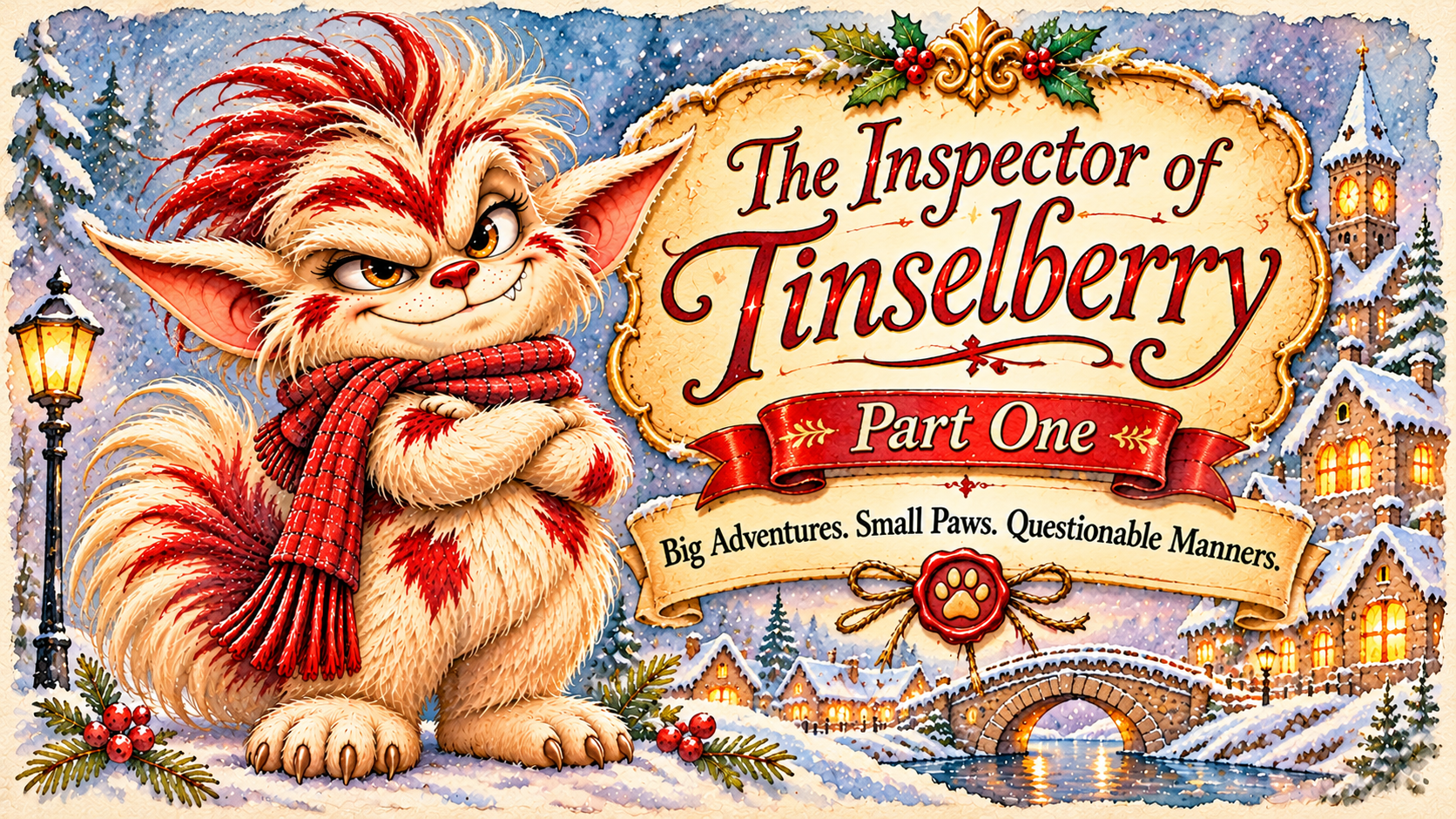
In Tinselberry, he sat in the last row, under a droopy pine branch, a lean cream-colored goblin with streaks of crimson fur down his arms and a wild crimson mane that never stayed flat. His amber eyes narrowed at the room. He wore a red plaid scarf pulled up to his nose, and his claws dug small dents into his folded arms. His left ear kept twitching toward the carolers by the fireplace.
He pinned the ear flat with one hand. “Traitor,” he muttered to his own ear.
“Shanny! Shanny, Shanny, Shanny!” Noodle Wobblewick came bouncing down the aisle, a small orange goblin in a yellow bobble hat with a jingle bell on top. Noodle never walked anywhere. Noodle bounced, spun, skidded, and finished every sentence gasping for air. He flopped onto the bench in a puff of powdered sugar, a pinecone bun in each fist. “They’re handing out first routes tonight! I want Gingerhaven! I want Gingerhaven so bad my tail hurts!”
“Your tail hurts because you sat on your tail,” Shanny said, flat as a pancake.
“Because I’m excited!” Noodle squeezed Shanny’s arm with both sticky hands and left sugar fingerprints on the sleeve.
Shanny went stiff as a fence post. He counted in his head. One. Two. Three. Then he peeled Noodle off one finger at a time. “Personal space, Wobblewick,” he drawled.
“Love you too!” Noodle chirped, and dropped a bun in Shanny’s lap.
Shanny scowled at the bun. Cinnamon curled up his nose. He did not eat the bun. He held the bun, because dropping a gift would be rude, and Shanny had standards. His stomach growled. Quiet, he thought. Nobody asked you either.
On the bench ahead, Mabel Thistlewick kept knitting without turning around. Forty winters of inspecting had earned her a seat in the balcony, but she preferred the benches, where the cocoa arrived faster. She wore a lilac shawl, her spectacles hung from a beaded chain, and a chipped mug of chamomile with honey steamed at her elbow. She spoke slowly, setting down each word like a teacup. “Noodle,” she said. “Sit. Still.”
“I am sitting still!”
“You are vibrating,” Mabel said, and sipped her chamomile.
Mabel had knit Shanny’s scarf over six sleepless nights. Shanny wore the scarf every day and swore he bought the scarf at a clearance sale. Mabel never corrected him. She only smiled into her mug.
At the front, Grand Tinsel Marshal Orla Pembrook thumped her pencil twice on the podium. Orla was the roundest goblin in Tinselberry, in a plum velvet dress with a spare pencil tucked behind each ear and a tin of peppermints in her pocket. Her spectacles slid down her nose. Her laugh started in her belly, traveled to her shoulders, and only then reached her mouth. She sharpened the pencil with her teeth.
“My darlings,” she said, her voice warm as a blanket fresh from the dryer. “Your first season approaches. Every town waits for you. Every wreath needs a score. Every cookie needs a verdict. Go forth, judge, and bring me back a story!”
The hall erupted. Barnaby Crumb, a mountain of a goblin in a green vest with brass buttons, leaned so far over the balcony rail to cheer that he cracked his head on a hanging star. The rafters rattled when he laughed. “Worth the bump!” he bellowed, rubbing the lump and reaching for his fifth gingerbread man. “Worth every bump!”
Scrolls got handed out. Names got called. Noodle drew Gingerhaven and shrieked so high a windowpane frosted over. Juniper Fenn, the tiniest goblin in the hall, drew Frostbite Hollow. She wore a periwinkle cape stitched with silver stars and carried a jar of snowflakes she had collected on the walk over. She clapped both hands over her mouth, and her ears fluttered like moth wings. “Oh,” she whispered. “Oh, how lovely.”
“Shanny.”
He did not move.
“Shanny, sweetheart,” Orla called, waving the pencil. “Front and center.”
He rose with the enthusiasm of a snowman headed to a sauna and scooped the bun from his lap into his pocket when he thought nobody was watching. Two hundred pairs of eyes followed his scarf down the aisle. Orla peered at him over her spectacles, studied her scroll, then peered at him again. Her smile wobbled and came back stronger, which was worse.
“Your route this season, my dear,” she said. “The Whitmore Pawtowns. Three towns in all: Barkington, Nuttingham, and Purrsia.”
Silence fell. Somewhere, a candy cane snapped. Barnaby whistled low from the balcony. Mabel’s needles stopped clicking.
“Three towns,” Shanny said, tail lashing. “Three. In the entire world, three towns.”
“Three is generous for a first season,” Orla said.
“I did not ask to leave Tinselberry.”
“Nobody asks. That is why we call the night the Sending.” She raised one eyebrow. “On your final mock inspection, you called the mayor’s tree a cry for help.”
“The tree leaned. The tree needed help.”
“You scored the carolers a zero.”
“Generous,” Shanny said.
Orla chuckled, belly first, then shoulders, then mouth. She leaned down and tapped his chest with the pencil, soft as a sleeping kitten. “You never fall for tinsel, Shanny. You spotted every cracked bulb in the mock village. Highest marks in Tinselberry history, and the lowest manners. Nobody lies to you about Christmas.” Her eyes twinkled. “Funny, for someone who despises the holiday.”
“I despise the holiday,” Shanny said, too quickly, and his left ear betrayed him by shooting straight up.
Orla only smiled and handed him the scrolls.
He marched for the door. Noodle tackled him on the threshold, arms locked around his middle, jingle bell ringing. “Write me! Say you’ll write me! Say you’ll write!”
“I will consider the possibility of a postcard,” Shanny said stiffly.
Noodle burst into happy tears. Shanny’s tail wagged once, hard. He grabbed the tail with both hands and held on until the wagging stopped.
Outside, the snow squeaked under his boots and the cold bit his nose. Halfway home, he stopped beneath the last lamppost on the lane, strung with golden lights. Beyond the lamppost, the road ran off into the dark, and Shanny had never walked past the lamppost in his life. He looked left. He looked right. Nobody was watching.
He tilted his head and stared at the lights for a long, silent moment, the way people stare at someone they are not allowed to love.
Shanny’s cottage sat at the far edge of the village, the only one painted charcoal gray among all the candy colors. Window boxes held holly he refused to water and somehow never died. Inside, a cold hearth, one armchair, and a kettle of black tea, brewed bitter, no sugar, the way he liked everything except one thing.
He dragged out a battered suitcase and packed with the care of a surgeon. Scarf, red, spare. Notebook, leather. Pens, four. Candles, six. A candy cane, ancient, wrapped in a handkerchief. A framed photo of a Christmas tree, swaddled in three sweaters.
He sat on the bed and held the frame in his lap.
“Three towns,” he told the photo, low and rough. “Three chances to see a thousand trees and pretend none of them move me.”
The photo said nothing. Photos rarely do.
“Don’t look at me like that,” Shanny snapped. “I’m doing this for the job.”
He kissed the glass, wiped his mouth on his sleeve, glared at the empty room, and zipped the bag shut.
Dawn would bring the sleigh-bus. Shanny planned to hate every mile. His tail had other plans.
Route: The Whitmore Pawtowns.
Luggage: One suitcase, one scarf, one photograph.
Official Position on Christmas: Garbage.
Share this:
- Print (Opens in new window) Print
- Share on Facebook (Opens in new window) Facebook
- Share on Tumblr (Opens in new window) Tumblr
- Share on Bluesky (Opens in new window) Bluesky
- Share on Threads (Opens in new window) Threads
- Share on Pinterest (Opens in new window) Pinterest
- Share on Telegram (Opens in new window) Telegram
- Share on WhatsApp (Opens in new window) WhatsApp
- Share on X (Opens in new window) X
Leave a Reply