
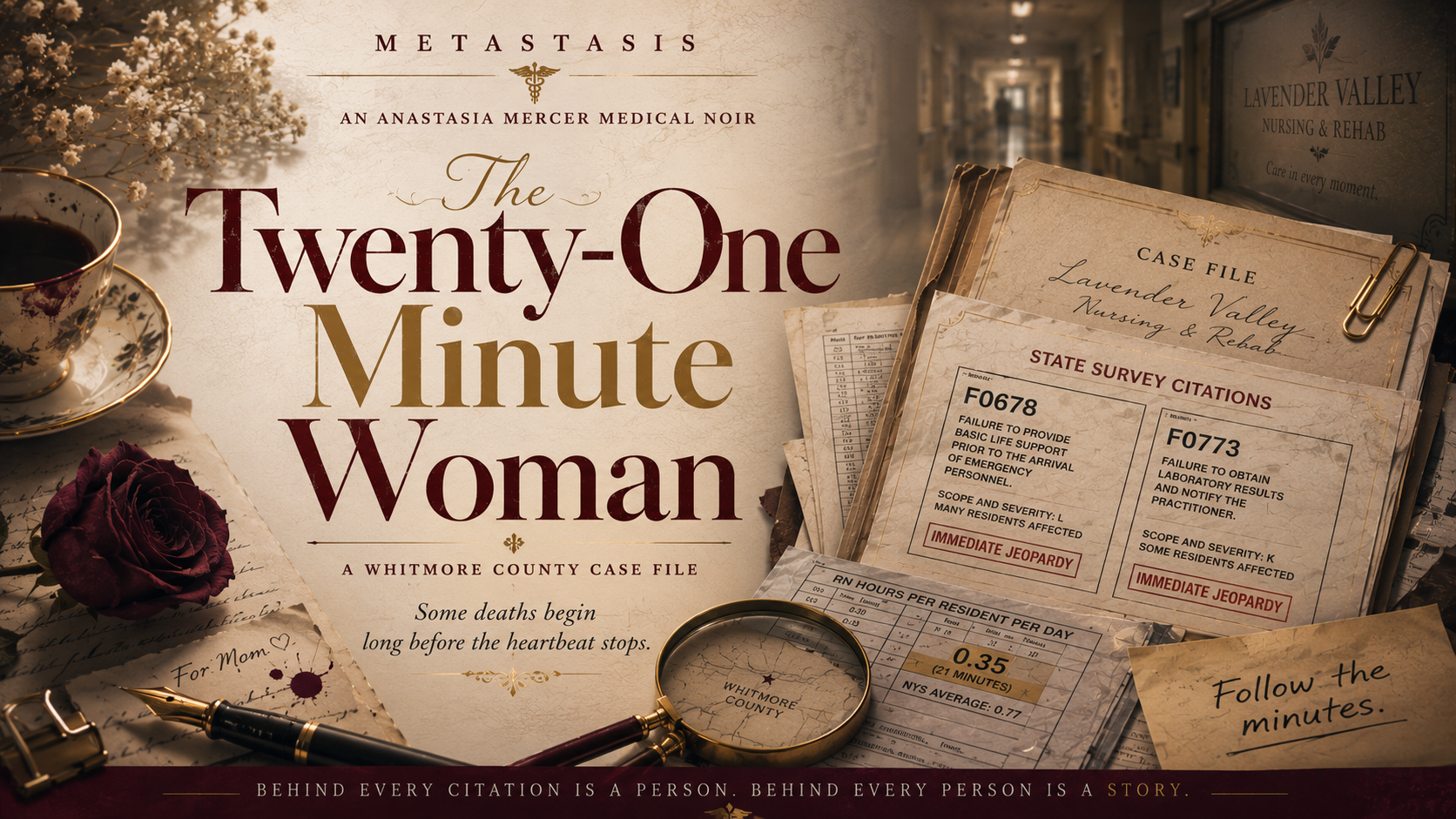
Metastasis · An Anastasia Mercer Medical Noir
Some stories are hard to say out loud. Some are hard to even look at, let alone read.
When I first learned about this case, about a standing order for CPR that was ignored, something in me went cold. These are not complex medical decisions. These are basic standards of care, and they were not met.
I knew I had to share this with someone. But I’ve learned that the best way I can do that is by turning real patterns and real facts into story. So yes, dear reader, this happened. And it will happen again if we stop paying attention to the people we love after we place them in someone else’s care.
Please read the full story. Three chapters. At the end of the last one, you’ll find where this really happened, and what the record shows.
And remember, you have the right to speak up, even when all you have is a suspicion.
Part 1
Chapter One: The Paper Before the Body
Anastasia Mercer did not go to Lavender Valley for the body. She went for the number.
Twenty-one minutes.
That was how much registered nursing time each resident at Lavender Valley Nursing & Rehab received in a twenty-four-hour day, according to the facility’s own reporting to the federal government. Half the state average. She had read it twice before she believed it, then a third time before she let herself get angry about it, because anger was a luxury she rationed as carefully as the corporation rationed payroll.
She spread the citations across her hotel bed like a hand of cards nobody wanted to be dealt.
F0678. Failure to provide basic life support prior to the arrival of emergency personnel. Scope and severity: L. Many residents affected. Immediate jeopardy.
F0773. Failure to obtain laboratory results and notify the practitioner. Scope and severity: K. Some residents affected. Immediate jeopardy.
Two codes. Two bureaucratic labels. A woman was dead, and somewhere inside those sterile descriptions lived the final minutes nobody had written honestly.
She had done this enough times to know the letters were never the whole story. The letters were where the story ended. The story itself lived further back, in the staffing sheets, the turnover logs, the wire transfers that moved money sideways instead of down to the floor where it was supposed to land. Somewhere in a ledger she hadn’t gotten her hands on yet, a line item explained why a woman with a standing order for CPR had died anyway, with staff standing close enough to touch her.
Anastasia had seen this shape before. She had built a career on this shape.
Meridian Health Partners owned Lavender Valley the way a landlord owns a building without ever smelling the hallways. It owned a dozen other buildings across Whitmore County the same way, buildings with soft names and hard math. Fortune Creek. Whispering Pines. And, four years ago, a facility whose name she no longer said out loud, because saying it out loud made her hands shake, and she needed her hands steady for what came next. The administrator from that building wasn’t even with Meridian anymore. The LLC that owned it still was.
She had been an auditor then. Not an investigator. There was a difference, though most people never understood it until it was too late to matter. Auditors documented numbers. Investigators asked who benefited from them.
She was done being an auditor.
Her phone buzzed against the bedspread. A text from a number she’d saved under a first name only, no last name, the way she saved every source who still had a badge and a paycheck to lose.
She’ll talk. Tonight. Diner off Route 9. She’s still wearing the badge.
Anastasia looked at the citations one more time before she gathered them into a folder. Twenty-one minutes. She wondered, not for the first time, what a nurse could possibly be expected to do with twenty-one minutes, and how many of those minutes had already been spent before anyone even knew there was a woman inside Lavender Valley who was dying for lack of them.
She picked up her keys.
The diner was fifteen minutes away. She would use every one of them thinking about the nurse she was about to meet, a woman who had walked into a building she didn’t know, to care for people she’d never met, using equipment she couldn’t find, under orders nobody had told her existed.
Twenty-one minutes hadn’t killed the resident at Lavender Valley.
Twenty-one minutes had only made sure nobody was watching when it happened.
Chapter Two: The Nurse Who Didn’t Know the Building
The diner smelled like burnt coffee and floor cleaner, which Anastasia had come to think of as the official scent of every conversation that mattered.
The nurse was already in a booth at the back, hands wrapped around a mug she wasn’t drinking from. Scrubs under an unzipped jacket, an agency badge still clipped to her chest like she hadn’t been able to make herself take it off. She looked younger than her file said she was. Exhaustion did that. It borrowed years and never gave them back.
“You’re the one who called,” the nurse said. Not a question.
“Anastasia Mercer.” She slid into the booth across from her, no folder, no recorder in sight, though the phone in her pocket was already running. “I’m not with the state. I’m not with Meridian. I’m not with anyone who can fire you.”
“Everyone can fire me. I’m agency.” The nurse finally looked up. “That’s the whole point, isn’t it. Nobody can fire the person who was never really there.”
Anastasia let that sit for a second before she spoke again. “Tell me about the night.”
The nurse’s hands tightened around the mug.
“I’d never been inside that building before. First shift, seven p.m., they hand me a badge and a floor assignment and nobody walks me through anything. No orientation packet. No code status sheet. I asked the charge nurse where the crash cart lived and she looked at me like I’d asked her something in a foreign language.”
“Did she answer?”
“Eventually. Wrong hallway. By the time I found it, I’d already lost four minutes I didn’t know I was losing.”
Anastasia didn’t write anything down. She didn’t need to. She had learned years ago that the moment a witness saw a pen come out, they started performing their own memory instead of living inside it.
“Walk me through the room.”
The nurse’s eyes moved to a point somewhere past Anastasia’s shoulder, the particular stare of someone stepping backward into a night she’d rather not revisit.
The call light wasn’t even on. That was the first wrong thing. A CNA found her unresponsive during a routine check, no pulse, no breath, and by the time anyone found me on the floor I was already the fourth person to touch that room and the first person with a license.
I didn’t know her. I want that said plainly. I didn’t know if she was full code or DNR because nobody had told me and the chart wasn’t pulled up on the computer by the door, it just said “see binder,” and there was no binder on that cart, there was no binder anywhere I could find in the ninety seconds I had to decide whether to start compressions on a woman I had never spoken to in my life.
I started anyway. That’s what you do. That’s what they teach you, when in doubt, you start, because CPR given to someone who didn’t want it is a mistake you can apologize for. CPR withheld from someone who did want it is one you can’t take back.
The charge nurse came in behind me. She didn’t help. She stood in the doorway and said, “She’s DNR, stop,” and I stopped, because she said it like a fact and I had no binder, no chart, no reason not to believe her.
The nurse blinked, and the memory closed like a door swinging shut.
“I stopped because someone with more badge than me told me to stop,” she said. “That’s the whole story. I stopped because I trusted the person standing in the doorway instead of trusting my own hands.”
Anastasia kept her voice level. “Do you have anything in writing? A text, an email, anything from corporate telling you not to talk?”
The nurse reached into her jacket pocket and set her phone face up on the table, screen already open to a message thread.
Do not discuss the incident with anyone outside the facility. This is a directive from administration, not a request.
Anastasia looked at the timestamp. Six hours after the resident died. Before the family had even been called.
“You still think she was DNR?” Anastasia asked.
The nurse didn’t answer.
She just looked back down at the coffee she still hadn’t touched, and Anastasia let the silence sit there, because some silences said more than a chart ever would.
Chapter Three: Twenty One Minutes
It took Anastasia six days to obtain the chart.
It took forty minutes to realize the chart wasn’t the story.
The story was everything missing from it.
The advance directive was the first thing she pulled, because it was the one document that couldn’t be argued with. It sat in the resident’s chart in her own handwriting, witnessed, dated, unambiguous.
Full code. Attempt CPR. No exceptions noted.
The charge nurse had been wrong.
Or she’d known exactly what she was saying.
Anastasia had stopped trying to decide which explanation frightened her more.
She laid the timeline out the way she always did, one line at a time, until the paper did the talking.
7:12 p.m., four days earlier. A critical laboratory value posts to the facility’s system. The kind of number that, in a properly staffed unit, triggers an immediate call to the on-call physician. No call is placed. No nurse opens the result for four more days.
9:46 p.m. A CNA finds the resident unresponsive during a routine check. No pulse. No respiration.
9:48 p.m. An agency nurse, on her first shift in the building, begins chest compressions. She does not yet know the resident’s code status. No binder is at the bedside. No chart is pulled up on the nearby terminal.
9:49 p.m. The charge nurse enters the room and orders compressions stopped, stating the resident is DNR. The agency nurse complies.
9:55 p.m. EMS arrives. The resident is pronounced dead at the scene.
3:14 a.m. Administration sends a directive to staff who were present, instructing them not to discuss the incident with anyone outside the facility. The resident’s family has not yet been notified.
Three days later. The facility completes its internal incident report. Corporate risk management interviews staff who were present. No mention is made of the lab result, the code status, or the order to stop compressions.
Four months later. A joint state and federal survey finds the facility in Immediate Jeopardy. Two citations are issued.
F0678. Failure to provide basic life support.
F0773. Failure to obtain laboratory results and notify the practitioner.
Civil penalty assessed. Correction plan filed. Facility remains open.
Anastasia read the timeline twice more before she let herself feel anything about it, because feeling came second in her line of work, and the numbers always came first.
Seven hours and twenty-nine minutes between the lab result and the death. Two minutes between the first compression and the order to stop it. Twenty-one minutes of registered nursing time to notice any of it before it became irreversible.
The state called it Immediate Jeopardy. Meridian called it an isolated incident. The family, when Anastasia finally sat with them, did not call it anything at all. They just called her Mom, and asked, quietly, whether anyone had been with her when it happened.
Anastasia did not have an answer that would make that easier to hear.
She closed the file the way she closed all of them, with the sentence that had followed her out of every building she had ever walked into with a folder under her arm.
The resident’s death certificate listed a cause of death.
The paperwork never listed the cause of the neglect.
People think neglect looks dramatic. Most days, it looks like a chart nobody opened.
The Real Story
Lavender Valley Nursing & Rehab is fictional. What happened inside it is not.
This Case File is based on documented findings from a real nursing home, the Onondaga Center for Rehabilitation and Nursing, in Minoa, New York. A resident there died in 2025 after staff failed to review life-threatening lab results for days, then withheld CPR despite an active medical order requiring it. State and federal inspectors cited the facility at the Immediate Jeopardy level, the most severe classification in nursing home oversight, for failing to provide basic life support and for failing to obtain and act on laboratory results.
The inspection reports and public reporting remain available.
Syracuse.com, “Central NY nursing home resident dies after staffers fail to read labs, then withhold CPR, NY finds”:
https://www.syracuse.com/health/2026/03/central-ny-nursing-home-resident-dies-after-staff-fail-to-read-labs-then-withhold-cpr-ny-finds.html
New York State Department of Health, official inspection record for Onondaga Center for Rehabilitation and Nursing:
https://profiles.health.ny.gov/nursing_home/poc_inspection_detail/1D7079
If someone you love is in a care facility, you have the right to ask for their chart. You have the right to ask who reviewed their last labs. You have the right to speak up, even when all you have is a suspicion.
Leave a Reply